
CPRL’s new Executive Group will help shape the future of policing research
Professor Clifford Stott, Academic Director, Centre for Policing Research and Learning
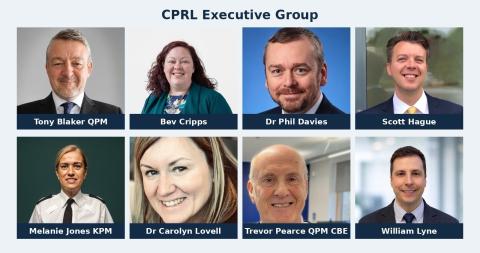
I’m pleased to announce the formation of CPRL’s Executive Group and to welcome Tony Blaker, Bev Cripps, Phil Davies, Scott Hague, Melanie Jones, Carolyn Lovell, William Lyne and Trevor Pearce. They bring a wide range of police officer and police staff experience, from operational command and criminal investigation to workforce development, digital transformation and the use of science in policing. Their experience will help us deliver our new strategy and sharpen our judgement about where CPRL can make the greatest contribution.
Our ambition is for CPRL to become the national hub for policing research. Across the UK there is considerable expertise relevant to the problems policing faces. What we see repeatedly is how difficult it can be to bring that expertise together around a shared problem and sustain the work long enough to make a difference. A force may be grappling with a problem that another has begun to address. Researchers may have evidence that could change how a decision is made yet have few opportunities to work with the people making it. As technology, crime and public expectations change, our capacity to make those connections matters more.
That is where a national hub can add value. CPRL can bring together police officers, police staff, researchers and other partners to define the problems that need attention, mobilise the expertise to investigate them and help turn the findings into changes in policy and practice. The Executive Group will extend the networks through which we can do that. Just as importantly, I want its members to challenge us. Are we asking questions that matter to policing and the communities it serves? Are we alert to emerging opportunities as well as immediate pressures? Have we involved the people who understand the problem and can act on what the research finds?
What our members bring
Tony Blaker QPM is a former Deputy Chief Constable of Kent Police and former National Police Chiefs’ Council lead for courts. His work on digital reform across policing and criminal justice gives him a clear view of what it takes to deliver change when responsibility is shared across institutions. He will help us think through how research can inform national reform and what it takes for evidence to influence decisions across organisational boundaries.
Bev Cripps leads training, learning and organisational development at the Police Service of Northern Ireland (PSNI). She brings a senior police staff perspective to the Executive Group, alongside her experience as an education leader. She will help us ensure that CPRL’s work reflects the experience of police staff as well as officers, and that research informs how both are trained and supported throughout their careers. Her work at PSNI gives her a practical understanding of how organisations learn from their workforce and put new knowledge into practice.
Dr Phil Davies leads the policing contribution to the National Data Integration & Exploitation Service and has a longstanding relationship with CPRL, including as a former vice-chair. His experience connects national work on police data with research on how police organisations are designed and operate. He will help us ask how better use of data can improve decisions and what evidence is needed to assess whether changes are delivering what was intended.
Scott Hague is Head of Delivery and Innovation for the Hertfordshire Police and Crime Commissioner. He brings a Police and Crime Commissioner’s office perspective to the Executive Group, alongside experience of digital transformation and AI adoption across policing, the public sector and industry. His work with government, academia and industry will help CPRL bring a wider range of expertise to questions about technology in policing. He will challenge us to ask what problem a new technology can solve, what it takes to put it into practice and how we can tell whether it has improved policing and the service the public receives.
Assistant Chief Constable Melanie Jones KPM leads Operational Support at PSNI and is the NPCC lead for protest policing. Her experience as a public order commander and national policy lead will help us keep research grounded in the judgements officers and commanders make in practice. She brings a perspective on how forces can learn from operational experience and use that learning to develop policy and practice in different settings.
Dr Carolyn Lovell is Head of Research in the Office of the Police Chief Scientific Adviser. Her work connecting policing with scientific and academic expertise will help us align CPRL’s programme with wider national research priorities and identify where we can make a distinctive contribution. She brings experience of building the relationships through which policing can commission, assess and apply research.
William Lyne leads Economic and Cybercrime at the Metropolitan Police. His experience across the Met and the National Crime Agency brings an operational perspective on how policing responds to rapidly changing threats, including fraud and cybercrime. He will help us connect research with the questions facing investigators and understand where collaboration across policing, academia and industry can improve the response.
Trevor Pearce QPM CBE spent 40 years in law enforcement, beginning his career in Kent before becoming Director General of both the National Crime Squad and the Serious Organised Crime Agency. He specialised in criminal investigation and intelligence, led national policy on serious and organised crime and oversaw complex international investigations. He received the Queen’s Police Medal in 2006 and was appointed CBE for services to law enforcement in 2014. His experience will help CPRL ask how research can inform the way forces and national agencies work together on serious and organised crime.
The CPRL team look forward to working with all eight members as we put the strategy into practice. I want their involvement to make a visible difference to the questions we pursue, the people we bring together and what happens once the research is done. That is how CPRL can earn its place as a national hub for policing research.
Read the Executive Group’s full profiles on our Meet the Team page.
Published 19 November 2026


Explore

Undergraduate
Postgraduate
Policy
-
Follow us on Social media
-


