
CPRL research to feature at major national symposium on Police-led Drug Diversion
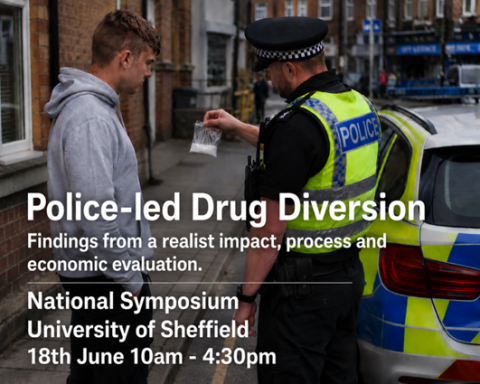
The Centre for Policing Research and Learning (CPRL) is contributing to a major national symposium on Police-led Drug Diversion (PDD) taking place at the University of Sheffield on 18 June 2026.
Hosted by the University of Sheffield’s Centre for Criminological Research, the National Police Chiefs’ Council and the College of Policing, the event brings together leading researchers, national policing stakeholders, policymakers, and practitioners to discuss the future of diversion-based approaches to drug-related offending and the growing evidence base surrounding their effectiveness. The symposium reflects the increasing national significance of diversion schemes as part of wider criminal justice reform and highlights the collaborative partnerships shaping evidence-based policing policy and practice.
There is a growing body of evidence demonstrating the benefits of pre- and post-arrest diversion programmes that provide alternatives to criminal justice processing by directing individuals who are found in possession of drugs towards education, support, and treatment services. Such approaches have been associated with reductions in recidivism and improvements in public health outcomes. Life opportunities can be enhanced by addressing the underlying causes of drug-related harms while also avoiding the stigma and wider social consequences associated with criminalisation.
Funded by the Cabinet Office, Dr Helen Glasspoole-Bird (CPRL) was part of a multi-partner research team, including the College of Policing, that carried out a realist evaluation of police-led drug diversion schemes across 13 English police forces, with a particular focus on three forces that had implemented established diversion programmes.
A realist evaluation differs from a conventional evaluation because it seeks not only to establish whether an intervention works, but also how, why, and under what conditions it produces particular outcomes. In this case, the research explored both the effectiveness of diversion schemes and the organisational and operational contexts that shape their implementation.
The outcomes of PDD for two groups of people were examined. Group 1 was made up of people who had been caught in possession of any drug controlled under the Misuse of Drugs Act. Group 2 was made up of people who were suspected of other offences, including theft, assault, and criminal damage, and had some history of drug involvement.
The use of diversion for the first group was found to be associated with lower risks of reoffending, both when comparing police forces that did or did not have PDD schemes, and when comparing similar individuals who were or were not diverted. At the level of police forces, having a PDD scheme was not associated with different levels of reoffending for the second group. However, diversion was associated with lower reoffending when comparing cases that had been dealt with through diversion to similar cases that had not.
Diversion was found to be used far less than it potentially could be, even in police forces that had established PDD schemes. The main reason for this was that police officers used their discretion to choose not to divert eligible offenders.
The full breadth of findings will be presented and discussed at the national symposium. This includes what the research team learned about the contexts in which PDD works, the mechanisms through which PDD schemes produce their outcomes, the cost consequences of employing schemes, and the equity of their use across different groups and settings.
The event demonstrates CPRL’s continuing contribution to nationally relevant, co-produced policing research developed in partnership with major stakeholders across policing, policy, and academia.
Keynote speakers include:
Dame Professor Carol Black – UK Independent Adviser on Drugs
Dr Alison Heydari – T/Deputy Assistant Commissioner, NPCC lead on out-of-court resolutions
Dr Paul Quinton – Evidence and Evaluation Advisor, College of Policing
Main session:
Professor Alex Stevens and the PDD Evaluation research team will present their findings, showing and explaining the effects of PDD in reducing reoffending, saving money in the criminal justice system, and influencing entry into drug treatment.
Parallel sessions:
Sessions will focus on diversion from Professors Sid Bandyopadhyay and Simon Pemberton (University of Birmingham), Jason Kew (The Centre for Justice Innovation), and Penelope Gibbs (Transform Justice), alongside additional discussions led by the research team on how to implement and optimise PDD schemes for best effect.
Published 01 June 2026
Publications associated with this research include:
Bacon, M., Glasspoole-Bird, H., Hendrie, N., Lewer, D., Mills, A., Monaghan, M., … Stevens, A. (2026) Implementation fidelity matters: insights from a realist evaluation of police drug diversion schemes in England. Policing and Society, 1-24. https://doi.org/10.1080/10439463.2026.2651196
Smith, R., Bacon, M., Helen Glasspoole-Bird, H., Hendrie, N., Monaghan, M., Sutton, C & Stevens, A. (2025) Achieving collaborative advantage in policing: strategic and frontline partnership in police-led drug diversion schemes in England, Policing: A Journal of Policy and Practice, Volume 19, paaf044, https://doi.org/10.1093/police/paaf044
Stevens, A., Agnew-Pauley, W., Bacon, M., Glasspoole-Bird, H., Hendrie, N., Hughes, C.E., Lloyd, C., Monaghan, M., Smith, R., Sutton, C.E., Williams, E. & Quinton, P. (2025) Cascading Constraint and Subsidiary Discretion: Perspectives on Police Discretion From Police-Led Drug Diversion and Stop and Search in England, The British Journal of Criminology, azaf050, https://doi.org/10.1093/bjc/azaf050
Stevens, A. & Glasspoole-Bird, H. (2023) Theory of change of police drug diversion: A revised programme theory. University of Kent, Canterbury. (KAR id:101726)
Sutton, C.E., Bacon, M., Glasspoole-Bird, H., Hendrie, N., Monaghan, M., Smith, R., & Stevens, A. (2025) Triggering motivations for change: exploring engagement in adult police-led drug diversion programs. Drugs: Education, Prevention and Policy, 1–14. https://doi.org/10.1080/09687637.2025.2566921
Upcoming Events
Online seminar: TBC
Tuesday, October 6, 2026 - 13:00 to 14:30
Membership Group Meeting
Thursday, October 15, 2026 - 10:30 to 12:30
Online, Microsoft Teams


Explore

Undergraduate
Postgraduate
Policy
-
Follow us on Social media
-


