
From Conversation to Coordination: CPRL's Emerging Role in National Problem Solving
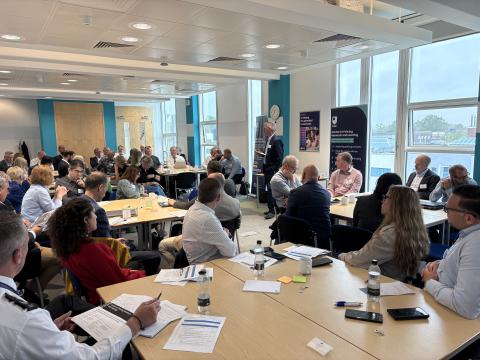
Today we publish the preliminary findings from the NPCC E-Mobility Workshop hosted by the Centre for Policing Research and Learning (CPRL) at The Open University. Delivered in partnership with ACC Nick Caveney, NPCC Lead for E-Mobility, DCC Catherine Akehurst, NPCC Lead for the Neighbourhood Policing Guarantee and Anti-Social Behaviour Portfolio, and Commander Kyle Gordon, NPCC Roads Policing Portfolio Lead, the workshop represents an important example of the collaborative leadership increasingly required to address complex and emerging challenges facing policing.
The report itself is about much more than e-mobility. It provides an important demonstration of CPRL's evolving role as a national problem-solving platform capable of bringing together the diverse organisations, expertise and perspectives needed to understand and respond to complex contemporary issues.
The workshop brought together representatives from policing, government, regulators, industry and academia to examine a rapidly emerging challenge that no single organisation can fully understand or address alone. What became immediately apparent was that the issue extends far beyond enforcement. Questions of public safety, criminality, product compliance, market regulation, customs enforcement, transport policy and technological innovation are deeply interconnected. Expertise exists across the system, but that expertise is often fragmented, making coordinated action difficult.
As ACC Nick Caveney reflected following the event, "this is not simply an enforcement challenge – and it is not one policing can solve alone." While e-mobility offers significant benefits in terms of affordability, accessibility and sustainable transport, it also creates emerging challenges relating to anti-social behaviour, criminality and unsafe or non-compliant devices entering the UK marketplace. The challenge is not whether e-mobility should exist, but how society can realise its benefits while reducing associated harms.
Importantly, the workshop highlighted that these harms cut across multiple policing portfolios. Concerns relating to anti-social behaviour, neighbourhood policing, road safety, organised criminality and public protection intersect within the e-mobility landscape, reinforcing the need for a coordinated national response that reaches beyond traditional organisational and policy boundaries.
One of CPRL's central strategic objectives is to help address precisely these types of complex challenges. By providing an independent space where stakeholders can share evidence, operational experience, professional expertise and policy insight, CPRL can support NPCC portfolio leads and policing partners in developing a clearer understanding of emerging problems and identifying opportunities for coordinated action.
Reflecting on the workshop, ACC Caveney noted that "a consistent theme from the day was the need to strengthen our understanding of the problem." While substantial expertise exists across policing, government, industry and academia, there remains no clear national picture regarding the scale, nature and drivers of e-mobility-related harms. Without that understanding, it becomes difficult to influence policy, prioritise resources or drive meaningful change.
The preliminary report published today demonstrates the value of bringing those perspectives together. Participants identified important gaps in current knowledge, highlighted limitations in existing intelligence and data systems, and began developing a shared understanding of the wider systems issues underpinning e-mobility-related harms. Discussions also identified a range of strategic opportunities for future research, innovation and policy development.
The workshop also exposed a significant gap in the current research landscape. While substantial attention has been devoted to the environmental, economic and societal benefits of e-mobility technologies, comparatively little research has examined their criminal and anti-social exploitation, the vulnerabilities they create, or the implications for policing, public safety and regulatory systems. Participants repeatedly identified the need for a more coordinated programme of research capable of informing evidence-based policy and practice in this rapidly evolving area.
More broadly, the discussions reinforced that many contemporary policing challenges are fundamentally systems problems. As ACC Caveney observed, "where systems are unclear, non-compliance follows; where they are simple, legitimate and accessible, the scale of the problem can be reduced, and focus can shift to those causing the greatest harm." Addressing issues of this nature requires collaboration across policing, government, regulators, industry and academia to understand how different parts of the system interact and where intervention can be most effective.
This workshop represents the first example of a new direction for CPRL. Our ambition is not simply to conduct research about policing, but to work alongside policing and its partners to help define problems, mobilise evidence, convene expertise and support the development of practical solutions to nationally significant challenges. The publication of this preliminary report marks the first step in what we hope will become an ongoing programme of strategic engagement around the most pressing issues facing policing and public safety.
We are grateful to ACC Nick Caveney, NPCC Lead for E-Mobility, DCC Catherine Akehurst, NPCC Lead for the Neighbourhood Policing Guarantee and Anti-Social Behaviour Portfolio, Commander Kyle Gordon, NPCC Roads Policing Portfolio Lead, and all those who contributed their expertise so openly throughout the day. Their collective leadership reflects the reality that e-mobility intersects with a range of policing priorities and cannot be understood through any single operational lens. The preliminary report provides the foundation for future work in this area, but it also demonstrates the wider potential of CPRL's model of evidence-led collaboration.
As CPRL continues to develop, we look forward to working with NPCC portfolio leads, government departments, regulators, industry partners, academics and our membership forces to apply this approach to other nationally significant challenges. The workshop demonstrated that when diverse stakeholders come together around a shared problem, it becomes possible to move beyond fragmented responses towards coordinated national solutions. Creating the conditions for those conversations, and helping to transform them into evidence-informed action, is precisely the role CPRL was established to play.
Published 08 June 2026



Explore

Undergraduate
Postgraduate
Policy
-
Follow us on Social media
-


