
Blog post - From evidence to action: Convening partnerships to build more Inclusive Workplaces in policing
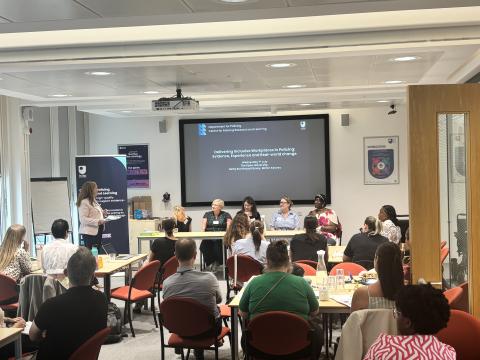
How do we ensure that research drives meaningful change in policing? This question sat at the heart of the Delivering Inclusive Workplaces in Policing: Evidence, Experience and Real-world Change knowledge exchange event, held at The Open University's Walton Hall campus on 1 July. Bringing together more than 50 delegates from across UK policing, including police officers and staff, academics, representatives from the National Police Chiefs' Council (NPCC), the Police Federation of England and Wales. The event demonstrated the value of bringing diverse perspectives together to tackle one of policing's most important organisational challenges.
Event programme
The programme reflected this ambition. Throughout the morning, delegates heard research exploring a range of issues affecting workplace inclusion, including policing families, inclusion and belonging, disability, representation within specialist roles, perinatal experiences, and the experiences of women of colour, and baby loss. While each presentation focused on a distinct area of research, together they painted a broader picture of the organisational, cultural and personal factors that shape people's experiences of working within policing.
Importantly, the conversations extended beyond identifying challenges. Across each session, a common theme emerged: there is increasingly robust evidence base available to support more inclusive policies and practices. The challenge now is ensuring that this evidence is accessible, understood and used by those responsible for shaping organisational change.
From evidence to implementation
That transition, from evidence to implementation became the focus of the afternoon. Contributions from the Police Federation of England and Wales and the National Police Chiefs' Council highlighted emotive current cases requiring Federation representation, and ongoing developments in family-friendly provision and national guidance. Delegates then came together to explore how research findings could inform local decision-making within their own organisations. Rather than ending with discussion alone, participants were encouraged to identify practical opportunities to embed evidence within policy, operational guidance and organisational practice.
The level of engagement throughout the day reflected both the importance of the subject and the appetite for collaboration. With standing-room-only attendance and lively discussion continuing well beyond the formal presentations, the event created an environment where researchers and practitioners could openly exchange ideas, challenge assumptions and learn from one another's experiences.
Event outcomes and future opportunities: CPRL and Knowledge Exchange
Perhaps the clearest measure of the event's success, however, came after it had finished.
In the days following the event, we have received requests from a number of policing organisations and forces and seeking access to data and evidence to support proposals for organisational change. New conversations around collaborative research and evaluation have also begun, demonstrating that delegates were not simply interested in hearing about the research, they wanted to use it.
For the Centre for Policing Research and Learning (CPRL), supporting opportunities for knowledge exchange is central to our mission. High-quality research has the greatest impact when it informs decision-making, shapes policy and improves practice. Achieving this requires strong partnerships between researchers, practitioners and policing leaders, creating opportunities not only to share evidence but to discuss how it can be applied within operational contexts. The requests for collaboration and evidence arising from this event are encouraging early indicators that these conversations are already beginning to translate into action.
The event also reinforced something that is becoming increasingly apparent across policing: no single organisation can address these challenges alone. Creating more inclusive workplaces requires collaboration across academia, policing, professional bodies and national organisations. Researchers need practitioners who are willing to test new ideas and evaluate change, while practitioners need access to timely, robust evidence that supports informed decision-making. Events such as this provide the space for those relationships to develop.
Building capability through partnership
As the evidence base continues to grow, so too does the opportunity to strengthen partnerships between research and practice. While individual police forces often experience these issues through a local organisational lens, these are, in reality, shared challenges across policing. As this event demonstrated, addressing them effectively requires collaboration that extends beyond any single force, organisation or discipline.
This is where CPRL seeks to add value. Our role is not simply to disseminate research, but to help policing recognise shared challenges, convene the right partners, mobilise evidence and expertise, and translate that collective knowledge into practical capability. Events such as this demonstrate how bringing together researchers, practitioners, professional bodies and national organisations can create the conditions for meaningful organisational change.
The conversations that have already followed this event illustrate that process in action. Requests for evidence, support with organisational change and discussions around collaborative research and evaluation all point towards a growing appetite for working collectively to address common challenges. CPRL will now build on that momentum by establishing a national working group to develop a more coordinated and resilient approach to research, evidence and practice in this area.
We welcome participation from policing organisations across the UK that share an interest in advancing evidence-informed practice. For CPRL members, these collaborations also provide an opportunity to help shape our research priorities, influence future programmes of work and become part of a national network that identifies shared challenges, develops collaborative solutions and builds capability across policing. Whether your organisation is already a member or is simply interested in contributing to this developing area of work, we would be delighted to hear from you. If you are exploring inclusive workplace initiatives, developing new policies or evaluating existing practice, please contact us at [email protected].
To find out more about becoming involved, contact the Centre for Policing Research and Learning at [email protected].
Upcoming Events
National Practitioner Programme: Evidence-Based Football Policing: Contemporary Practice, Innovation and Future Challenges
Tuesday, October 6, 2026 - 10:00 to Thursday, October 8, 2026 - 12:30
Online seminar: TBC
Tuesday, October 6, 2026 - 13:00 to 14:30


Explore

Undergraduate
Postgraduate
Policy
-
Follow us on Social media
-


