
Blog post - Building the next generation of football policing: Research, professional development and national learning
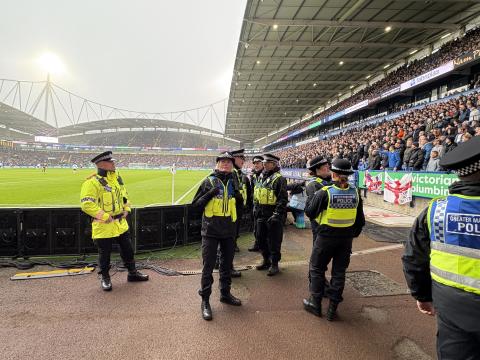
At time of writing this blog the FIFA Men’s World Cup is still unfolding across North and America and Mexico, football is once again at the centre of global public attention. The tournament is a reminder not only of the game’s extraordinary cultural reach, but also of the complex operational environments that major football events can generate. With England preparing to face Norway, and with the realistic possibility of further progression toward a semi-final against Argentina and even a final against France, the tournament provides a timely reminder of the demands that football success can place upon policing, public safety and crowd management.
Yet the exceptional environment of a World Cup should not obscure the routine reality of football policing in England and Wales. The new domestic season is approaching rapidly, and it is within that week-in, week-out environment that policing faces its most sustained pressures. Looking further ahead, preparations for UEFA Euro 2028 across the UK and Ireland reinforce the need for football policing to continue evolving through innovation, evidence and professional learning.
Over the last five years, football policing has undergone significant change. As we argue in a forthcoming paper, the challenge is not simply one of public order. It is also a question of productivity, efficiency and the effective deployment of finite policing resources. Forces must respond to evolving supporter cultures, changing patterns of risk, increasing expectations around legitimacy and proportionality, and growing pressure to deliver safe, effective and evidence-informed operations.
It is within this changing context that the Centre for Policing Research and Learning is playing a key role in supporting the evidence-based transition now underway in football policing across England and Wales.
Perhaps the most significant strategic development during this period has been the evolution of the UK Football Policing Unit's operational model. Since 2021, football policing has increasingly moved beyond traditional approaches centred primarily on intelligence gathering and disorder management towards a broader model that places greater emphasis on community engagement, dynamic risk assessment, facilitation and evidence-informed decision making.
Central to that evolution has been the introduction of the Operational Football Officer (OFO). More than simply replacing the former 'Spotter' role, OFOs represent a fundamental shift in how policing understands and manages risk within contemporary football environments. Alongside Dedicated Football Officers (DFOs), they play an increasingly important role in engagement with supporters, real-time assessment of changing circumstances and supporting proportionate operational decision making.
As operational practice has evolved, so too has the need to understand what works.
Through the ENABLE project and, more recently, the National Observer Programme for Football Policing (NOP-FP), delivered in partnership with the UK Football Policing Unit, researchers at the Centre for Policing Research and Learning (CPRL) have been working alongside police forces across England and Wales to systematically observe football operations. What began with seven participating forces has now expanded to more than twenty-five, creating the largest programme of independent observation and evaluation ever undertaken within UK football policing.
This partnership has generated something that has never previously existed: a substantial and growing evidence base that allows policing to examine contemporary operational practice in a systematic way. Rather than relying solely on experience or tradition, forces are now beginning to understand how different approaches influence legitimacy, public safety, operational effectiveness, resource efficiency and supporter behaviour.
Importantly, this research is helping answer some of the questions that matter most to practitioners.
How should OFOs and DFOs work together most effectively? How can engagement improve dynamic risk assessment? Which deployment models appear to deliver the greatest operational benefit? How can forces improve efficiency whilst maintaining effective public safety outcomes? And how should football policing continue to evolve in preparation for future challenges?
Many of these emerging insights are brought together in our forthcoming academic paper, Rethinking Football Policing: Risk, Accountability and the Persistence of POPS, which synthesises learning emerging from the National Observer Programme and reflects on the implications for future operational practice. Generating evidence, however, is only one part of the process. The equally important challenge is ensuring that research informs professional judgement, operational practice and organisational learning.
It is this challenge that has led CPRL, working closely with the UK Football Policing Unit, to launch its new National Practitioner Programme: Evidence-Based Football Policing: Contemporary Practice, Innovation and Future Challenges, taking place at The Open University from 6 – 8 October 2026.
The programme has been designed to complement existing College of Policing provision by providing practitioners with an opportunity to explore the evidence underpinning contemporary football policing in greater depth. Rather than focusing solely on operational procedures, participants will examine why different approaches succeed or struggle, how research informs professional judgement, and what contemporary evidence tells us about effective practice.
To support Expressions of Interest, we have also published a short briefing paper setting out the rationale for the programme. The paper explains the strategic context underpinning the event, its alignment with the ongoing evolution of football policing nationally, and the organisational benefits of participation. We hope it will provide practitioners with a useful resource when discussing attendance with senior leaders and making the case for investing in organisational learning and professional development.
Across three days, delegates will explore the theoretical foundations of contemporary football policing, examine operational learning emerging from the National Observer Programme, consider developments in law and national policy, analyse significant operational case studies and discuss the future challenges facing football policing, including changing supporter cultures, safeguarding, youth risk groups and preparations for UEFA Euro 2028.
Bringing together researchers, Football Leads, commanders, OFOs, DFOs and other public order practitioners, the programme aims not simply to deliver continuing professional development but to strengthen a national community of practice committed to evidence-informed policing.
The timing of the programme has been chosen deliberately. Scheduled during the October international break, it has been designed to minimise operational abstraction and maximise opportunities for practitioners actively engaged in football policing to participate.
Expressions of Interest now open
We are currently inviting Expressions of Interest from police forces and partner organisations.
At this stage, Expressions of Interest will help us understand anticipated demand and plan the logistics and capacity for what we expect to become a flagship national professional development event. There is currently no limit on the number of delegates that organisations may express an interest in sending, although initial allocations are likely to be made on a fair basis should demand exceed capacity. CPRL member organisations will receive priority access together with discounted registration.
Football policing has entered a new phase of its development. The challenge now is to ensure that professional learning evolves alongside operational practice. By bringing together research, national policy and practitioner experience, the National Practitioner Programme represents an important step towards building a stronger evidence base, supporting innovation across forces and creating a national conversation about the future of football policing.
We look forward to welcoming colleagues from across England and Wales to The Open University this October.

Upcoming Events
National Practitioner Programme: Evidence-Based Football Policing: Contemporary Practice, Innovation and Future Challenges
Tuesday, October 6, 2026 - 10:00 to Thursday, October 8, 2026 - 12:30
Online seminar: TBC
Tuesday, October 6, 2026 - 13:00 to 14:30


Explore

Undergraduate
Postgraduate
Policy
-
Follow us on Social media
-


