
Caridad Svich
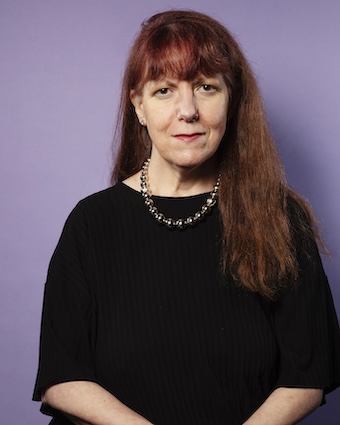
Caridad Svich is a US-based playwright, songwriter, editor, educator and translator of Cuban-Argentine-Spanish-Croatian descent. She is the author of over fifty plays, and the translator of dozens of works of Spanish-language literature. Her work centres on environmental and human rights, examines the poetics and politics of resistance, and often radically reconfigures the classics. She has received numerous awards, including the Dramatists Guild Flora Roberts Award in 2023, the ATHE Ellen Stewart Career Achievement in Professional Theatre Award in 2018, the Tanne Foundation Award in 2018, and the OBIE Award for Lifetime Achievement in 2012. She was a Guggenheim Fellow in Drama in 2024. She teaches at Rutgers University-New Brunswick, NYU School of Professional Studies, and the Einhorn School of Performing Arts.
This interview with Christine Plastow took place in January 2025. A PDF file of this conversation is available for download.
Christine Plastow: Could you begin by describing how you’ve engaged with Greek tragedy, and Greek myth more generally, throughout your career?
Caridad Svich: The first time that I really dove into this area was actually by accident. I was working on notes for a play that were inspired by the femicide in Ciudad Juárez in Mexico. I wanted to write something that felt kind of documentary. This was in the early aughts, and there weren’t any other plays that dealt with this subject, so I felt an urgency around it.
Around the same time as doing notes for this other play, I took a workshop with Charles Mee, the famous playwright and historian, who does a lot of adaptations of ancient Greek tragedies. It was a workshop for ten days in Los Angeles. I was a fan of Chuck’s. We had been in conversation about some things, and he said, I want you to take my workshop. And I was like, oh, what a great opportunity to take a break. What I didn’t know was that there was an assignment for the workshop. He said, I want everyone in the workshop to write a ten-minute version of Iphigenia in Aulis by Euripides. I was angry because that’s not what I wanted to do. I was like, why is he asking us to do this? And I was whining and complaining. Anyway, he said, you can choose any translation you like. So I thought, OK, and I fell in love with the W. S. Merwin version. He was a wonderful American poet. I really, really love the language in his version, and it was my first encounter with that story. So I read it and then I was kind of obsessed with it. I wrote my ten-minute version and did the workshop with Chuck. I was really inspired by it. And I went away from that workshop thinking, oh, I’ll set that aside, that’s done with, and now I’m going to go back to the play that I’m writing. And what happened is that those two projects started to superimpose themselves upon each other, and I ended up writing a play called Iphigenia Crash Land Falls on the Neon Shell that was Once her Heart: A Rave Fable.
That was my first official plunge. Prior to that, I did write a play called Steal Back Light from the Virtual, which is a play that deals with the Minotaur and Theseus and Ariadne, and it’s basically about a serial killer, and about commodification and globalisation and, like lot of my work, about who gets left behind in society. It’s a modern play, but those figures are in it, and the idea of the sacrificial boys that are fed to the Minotaur is in that play. So I guess I was already in the mood, but I hadn’t formally acknowledged it. Iphigenia was the first one where I was like, oh, this is a path that I’m on. And so that led to a whole series of plays. I did at least two versions of Antigone. There was a version of Medea that’s called Wreckage. There’s kind of a cross-gendered Orpheus and Euridice called The Tropic of X. I edited a book called Divine Fire, which is about adaptations of Greek drama. It became my second milieu, as it were.
I felt like it liberated something in my writing which I had been working towards. I have these different sides to my writing voice. One of them is what I call acoustic, usually based in the American vernacular or a kind of invented American vernacular – a roots kind of Americana, like a folk song or a murder ballad. Then there’s this other side of my work that’s very urbane and brutal and usually about very intellectual topics, or kind of heady. And those two sides never quite met before. As a writer, I kept them separate. In Iphigenia Crash Land Falls, I made a very conscious decision to leave the folk stuff behind, and I didn’t want to do anything that was sort of roots, Americana, vernacular or anything, but I wanted to make something that felt very electric and very charged. As a writer, I think you’re always looking for the permission to acknowledge the poetic with fearlessness, which I think I had been hiding. Part of this has to do with, especially in US theatrical tradition, an emphasis on realism. I could do that as a writer, but it’s not my primary mode. But I kept being told that that’s what you have to do. So I think that one of the things that working through the mythological has allowed me to do is liberate that aspect and say, oh, I can have a chorus, and they can speak in verse and it’s fine. That is part of our tradition in Western drama, you know, and why not acknowledge that? I found it freeing in a wonderful way, and also I think it upped my game as a writer.
CP: You’ve already touched on so many of the things that I wanted to ask you about. I read Iphigenia Crash Land Falls over the past couple of days and I have questions about that in particular, because I loved it. But I was also looking on your website at the various work that you’ve done, obviously including Greek plays, but also many other things. Adaptation and translation seem to be a huge part of your work in general, in all your work with Lorca and with other Spanish writers and Shakespeare and loads of different source material. I was interested to hear what the value of adaptation and reinterpretation is for you.
CS: I think sometimes there’s a backlash around it: why is somebody adapting? I read on one theatre’s website what kinds of pieces they accepted and one of their rules is nothing that adapts anything else. I stopped for a second. First of all, I was angry. And then the second thing that I reacted to was that we’re always adapting. That’s what writers do. We’re adapting from the news. We’re adapting from real life. We’re adapting from our friends’ conversations. Adaptation is part of the writing process and this notion that things just come fully formed from the head of Zeus, as it were, is just not true. I love the acknowledgement that we’re in a stream of writing and streams of theatre and theatre making and acknowledging that, hey, here’s my little seed in this conversation. It has to do with acknowledging that we’re in the world with other art and with other kinds of thinking.
And then of course, through that, I think there are some specific political choices. I separate my work as a translator from reconfiguration or adaptation, which for me are different things. A lot of my work as a translator has to do with loving the work and wanting to have it exist in American English, and introducing writers to a new language and a new audience. That feels for me like a political mission. The other part of it is just because I get obsessed about certain characters, like in Shakespeare. I want to rescue them and create new lives for them, and I feel like they’ve been mistreated in other places and so I want to save them. Sometimes it’s as if they haunt our imaginary. If you’re writing in English, you can’t pretend that Shakespeare doesn’t exist, right? And if you’re in theatre, even more so. And so for me, it has to do with wanting to speak back to the canon, and I want to interrogate it and I want to smash it sometimes. I want to rub up against it and say no, you’ve done this wrong.
With the Greeks it’s more about stepping into something so old. It’s pre-Christian. For me, that’s a really fascinating space to be in. A lot of Western drama tends to be built around a kind of Christian model. I’m interested in stuff that’s pagan. I’m interested in ritual and ceremony in that sense. But I’m also interested in the fact that a lot of Western drama also comes from places that mimic or echo some of the deep problems in current society. Classical Athens was built on slave labour, right? There were people excluded from seeing the plays, it was for a very specific crowd. I think that all those things are mimicked in US culture. I want to acknowledge that because I think sometimes what happens with ancient Greek plays is that they’re divorced from their contexts. They’re seen as pristine artefacts. They’re not pristine. They’re actually quite dirty. I like the dirtiness of it, and I mean dirty in a socio-political sense. It’s dirty, it’s messy, it’s weird.
CP: When I read Iphigenia Crash Land Falls I was really struck by how much of the form of Greek drama you had in there. The Fresa Girls are a kind of chorus. I really love the satyr play element in it and the idea of masks and the songs, which are like choral odes. Could you say more about your interest in the form of the tragedies?
CS: I’m always interested in form even when the plays are not ostensibly inspired by ancient Greek plays. I love the chorus. I love what the chorus can do. One of the things that I wanted to do was preserve this idea of ‘speak song’, and of something that felt ceremonial. When I was structuring the play, I was really thinking about the first act feeling like an opera. In the operatic form, you can have the aria, you can have the choral part, and all those things are coexisting. One of the things that I love about Euripides’ plays, the ones that we know of, is that they do feel operatic. There’s a scene and then there’s the chorus and then there’s something that’s sung. They’re all complementary. The form is dramatic. The form is in tension with itself, instead of being one thing, and I was excited by that.
I’m interested in satyr plays too and so I thought, well, I’ve got to do a satyr play inside of this play because that would be so much fun to do. One of the things about what I call explosive or operatic form is that it allows for the dialectics to emerge in relief. I kept thinking about it in terms of looking at Greek vases, so like this Greek vase scene next to that Greek vase scene next to that one. So if we’re looking at them, as through a vitrine, we’re seeing the different vases or painting the different scenes of the play but they’re all in the same vitrine, they’re all speaking to one another. I wanted to have that feeling about the play.
So for me, the first act is like an opera, and I was very intent on the second act being like the ‘play’ version of the play. Then the third act is ritual. For me, the third act is very much like we’re just walking through the stations of a ritual, leading to the idea of sacrifice. And what does sacrifice mean? For me, one of the interesting things about Greek drama and form is that it’s rooted literally in the notion of sacrifice – things are sacrificed on the altar. I do think that’s essential to drama. One of the things that drama can do at its best, whether it’s through comic or tragic means, is talk about what we are sacrificing in culture. Why? How is that being sacrificed? I’m interested in that space of what gets placed on the altar, whether it’s a real altar or metaphorical one: whose blood gets let and why? How is that blood revered or not?
In a caste system, the upper class or the 1%, shall we say, will be revered in death. They become the icons. And the 99% are disposable. The 99% are not thought of, not remembered. They’re haunting the space. The Fresa Girls are haunting that space. But they’re also revering the iconic 1%. The adoration of Chanel, the adoration of status symbols, designer clothes, things that have to do with the elite. So I wanted to deal with the idea of the caste system. Wallace Shawn, who I think is one of the greatest US playwrights of the twentieth century, in an interview not long ago was talking about drama, and he said the failure of American drama has been that it’s forgotten how to write about the ruling class. And he was referencing Greek drama. The Greek dramatists were actually pointing right at power and saying, look, this is happening - yo, wake up! And I think that’s one of the things that still excites me about Greek drama, is that it’s provocative and it takes power to task and shows power for what it is.
CP: I wondered if you could say something about the fact that this play is set in a Latin American context and what specifically might happen to Greek tragedy in that context that might be distinctive?
CS: There’s a very healthy tradition in Latin American drama of interrogating and interacting with mythological figures from the Greek world, but also ancient Greek tragedies. One of the first plays that I read from Latin America was Antígona Furiosa, Griselda Gambaro’s play. It was the first time, as a reader, that it occurred to me that you can actually do this in a South American, in that case Argentine, context. It hadn’t occurred to me that that was even possible, which I know sounds very naive, but I’m thinking of myself being in grad school and going like, oh right, you can do this! And you start to read other writers that are playing that field of, how do we take on these stories which are said to be universal? That’s another other question - are they really universal? Are they being used as a kind of universal frame? But what is true, as is true of Hamlet and other things, is that there are these figures, these characters, that feel alive. Antigone feels alive, right? Antigone feels like she’s with us. Medea feels like she’s with us. So I think that there are characters that feel like they transcend consciousness, and maybe it has to do with the repetition of those stories.
The lens of Antigone was useful, I think, among other things, from a feminist perspective, but also from a political perspective of speaking truth to power. I’ve been thinking about that a lot in the current US context of a lot of censorship and a lot of self-censorship. You can go at things sideways, sometimes through myth, or you can say, it’s just a Shakespeare, you know what I mean? It’s just the ancient Greeks. And I think for some odd reason it’s received in a different way, like people go, oh, right, it’s a myth. And then of course, inside of it, you’re telling the story of somebody who has lost their brother and needs to have them buried, and there’s a state not allowing that. So I think that there’s something around the idea of displacing narrative – displacing something from a cultural context and applying it to a new cultural context – that sometimes allows for the source world to be illuminated in a different way, in a more vital way, maybe. Could Gambaro have written about Antigone in an Argentine context as speaking truth to power if it wasn’t Antigone?
I was at a conference and most of us were Latinx artists, and of course, what ends up being asked of us is what other Latinx artists do you read? My shelf is full of all different kinds of writing, and I read all kinds of people, so this idea that we should only read within our borders is not true. So I think that one of the things that drawing from ancient Greeks or other sources does is it kind of says, hello, we’re in the world. Now, there are questions around that. In another sense, Shakespeare’s a tool of empire, right? So I think that when you’re adapting Shakespeare within a Latinx context, it’s complicated, because it’s a colonial instrument. How you’re decolonizing that colonial instrument becomes crucial. With the ancient Greeks it’s similar, but different in the sense that, at least in the US context, it’s not common parlance. One of the exciting things for me about working with Iphigenia was that it’s not a play that a lot of people know. It’s not like Oedipus. It’s not in the cultural consciousness in a big way. So I thought, great, I can actually bring this story back, recontextualise it for you, and also speak about the global North’s ravaging of the global South. There’s a long and strong tradition of that.
So I think that the ‘staying within your borders’ kind of nonsense has to stop. And I think it’s pernicious - it feels like dominant, white-centric European drama kind of says, we are the only ones allowed to work in that international realm, and everyone else stay in your lane, you know? And I’m like, no, I’m not going to do that.
CP: Thinking about that ‘stay in your lane’ idea, I think the power of these texts is what makes them useful to invert. I think about things like suffragettes reading Medea at their meetings. When you take something that has that kind of cachet to it and you do whatever you want with it, especially somebody from a non-elite, non-white European background or whatever the dominant culture is - it has that additional weight, more so than something that doesn’t have that kind of cultural cachet to it.
CS: There’s also, I think, a reaction to realism as a dominant form. One of the things that happens when you interact with mythology and or with ancient Greek drama is that you’re not in realism anymore, so immediately it releases you from that burden, and it’s very exciting. I think about Sarah Kane’s work as being very Greek, tragic, and self-consciously so. It’s a signal that it’s not realism.
CP: That comes back to your point about displacement, which I think is also really useful. And, of course, is also exactly what the Athenians were doing with tragedy because they were saying, well, none of this stuff is about Athens. It’s about Thebes. So if this is all happening in Thebes, it makes it safe for us to think about what’s actually going on in Athens. You probably know the story about the play The Fall of Miletus which was too close to home for the Athenians - please don’t tell us about our recent military defeats, go back to writing about figures from myth. It gives that safety to explore questions that can be really dangerous.
CS: There’s also the sense that you’re not isolated in history, that the stories have been told before, that this abuse of power has happened a thousand times before. Here it is again. There’s an acknowledgement of historical complicity around abuses, especially human rights violations. It’s not like it just happened yesterday. No, it’s been happening. I’m not saying that it excuses power from its abuses. But when people are treating certain contemporary political figures as unique, I’m like, no, there’s a hundred of them, there’s a thousand of them. They’ve existed before. And I think that’s useful for us to think about, and to think about why these patterns, these figures keep reappearing. Sometimes myth helps us create that necessary distance, right? Like I need a screen to see the screen.
CP: One other thing that I was interested in on reading Iphigenia Crash Land Falls was her reflexivity. She talks about herself in the third person a lot and she’s kind of narrating her own story and her own fate in some way. She says she’s seen herself die over and over, story upon story. It really made me think of this process of reception or adaptation of stories as that reflexive process that happens over and over again and kind of accretes as it goes on, and sets of relations form between sources.
CS: I wanted the idea of the third-person point of view in the play. Again, it was this distancing effect, but also Iphigenia is aware that there’s another Iphigenia, and that there’s another one, and there’s another one. And yes, her story’s been told before, but she thinks it’s going to change now, right? I think that’s the thing about drama, the idea that maybe this time it will be different. Of course, there’s hubris in that. But there’s also genuine belief. Can’t we break the cycles of violence around femicide? I also wanted to create the opportunity in the play for a kind of internal chorus for Iphigenia, for her to be her own chorus. The only way I thought of at the time to do that was to have her be able to speak of herself in the third person. So she has the ability to split herself into a choral voice, but then also have an actual chorus in the play. That was a technique that I wanted to observe and play with.
A lot of the play is about seeing yourself. I’m seen by the media like this, but I’m actually like this: which version of Iphigenia is it? There are different images and versions of Iphigenia that exist in the world. As I was working on the project I was looking at Racine and other versions and was thinking about how that story’s been framed by different authors at different times in history and wanting to let that into my consciousness - also in the history of visual art, music. And I was thinking about how fun that is, in the sense that the playground becomes very vast. It is networked, it’s not linear because they’re all there. Maybe that has to do with how you draw from sources as an artist - sometimes they’re not chronological and they’re certainly not contiguous. I grab this source and then there’s this other source and another source, and if I were looking at them in front of me, they’re all next to each other. And I think, oh, that’s interesting - this from this century, but that from that century, but now they’re juxtaposed. So what does that juxtaposition do? There’s these interpretations of what people feel is a singular text, and then of course the question that I have is, is there a singular text? Does that even exist? Maybe not. I think that what we think of as a source or origin of something is actually not singular, but a kind of nexus.
CP: It’s around twenty years since you wrote Iphigenia Crash Land Falls. Has your approach to Greek material has changed in that time? Are you still working with Greek myth? I know you are, because I’ve had the opportunity to read your new play Minotaur.
CS: One of the things that happened right after Iphigenia, when I wrote the next series of plays that live within this sort of ancient Greek tragic haunted space is that they got very quiet, I think in reaction to Iphigenia, which is a very loud play. It’s loud, it’s aggressive, it’s in your face in all senses. That was quite intentional. And then I wanted to make things that were not that. I wanted to make things that were very still, that were much more mysterious, opaque, that felt hidden, that felt veiled. So that also affected the poetry of those plays that followed. Things get foreshortened a lot in the plays that follow, they get less explicated, they’re more elliptical and more abrupt.
I wrote a series of plays called American Psalm, which starts with a play called Red Bike. Those plays are back in that folk vein of mine, that American vernacular vein, but they also have songs within them. So there’s the reintroduction into those plays of a choral voice. There’s lot of sharing of narrative and splitting the narrative, things I hadn’t done in Iphigenia. What if they’re twelve Iphigenias? What if that voice is shared by a lot of different voices? That’s something I’ve been playing with more in the last couple of plays.
I’ve also been thinking a lot about verticality in terms of language. I was really obsessed with the horizontal text when I was working on Iphigenia, even though that play is very vertical. As I’ve moved forward, I’ve been leaning more and more vertical, so I’m thinking a lot about the notion of the relationship between the heavens and the underworld, and also thinking about the idea of: how does text fly upwards? How can it fly upwards? For example, in Minotaur, the shape of the text on the page is very vertical and that’s quite intentional. I wanted it to be kind of like a column, and on that column is a statue of the minotaur. The shape of figure and space is something that’s become more central. I think maybe it goes back to this notion of Greek vases – of thinking about the play being on the vase, but more literally, like what if it is a vase on stage and that vase is speaking. There was an incredible production that Robert Lepage did of Coriolanus at Stratford Festival, you can see it online, and it starts with an enormous bust of Coriolanus speaking. And I was like, yes, that’s exactly what I want. I want that feeling of statues coming to life.
CP: The final provocative question is, should we still be working with Greek tragedy or should we let it die? The less provocative question is how do we continue working with Greek tragedy in a time where it feels increasingly urgent to not reproduce the imperial or colonial power structures that have been, certainly in the British context, associated with those plays?
CS: It’s very difficult. A lot of it comes from actor training and theatre training. You usually start with the classical. So that has to be bust open. It’s like, is that really the beginning? Why is that the beginning? It also has to do with translation. There’s a very healthy sphere of classical translation that has allowed these pieces to be still in circulation. So it’s not just that they’re being taught in acting school, but we have a hundred versions of Oedipus. That’s what got translated, which again is a colonial thing. So I think it’s like busting open this idea of seeking out translations of other work, work that predates this work, work that’s not from Greece. An interesting thing for me about Greece is that it’s Mediterranean and it’s a very specific culture and often it’s not taught that way. It’s taught as if it were European. I would say, embrace the fact that it’s not European, embrace the fact that it’s very Mediterranean, it’s not, I don’t know, Nordic or British or Gaelic. It’s from a different kind of sensibility. I’m hungry for much more of an understanding of that.
Two years or so ago, I forget which production it was, but there was a production from Epidaurus streamed worldwide. And it was thrilling. There was so much chanting. The whole thing was chanted. And I was like, this is awesome. Why don’t we know this? Why, when I see an Electra, is it staged like a British drawing room play? It’s people chanting and it’s epic and it’s physical and it’s messy and it’s harsh. It’s deeply weird, in a good way. I think we need that feeling that it’s ceremonial, it’s not soft spoken. It’s a lot of people debating their problems with one another in a way that’s true. But what I also loved about it was that it was declamatory, in the best of senses. We are taking this poetry as poetry, and we are lifting it in that way, and we are speaking in the open air and trying to reach everyone. And it’s awesome. These are plays that were meant to be spoken within and coexist with the natural world. To me, that’s something we’ve lost, because of indoor theatre. Things have gotten smaller. Every set is like a white box, with neon or perspex, but actually they’re meant to be with the earth. That’s what I meant about ‘messy’ too. The Earth is right there; the toxic fumes are right there. That’s Greek tragedy, right? It’s in that. It’s in the relationship between the ‘natural’ world and this mediated site of a theatre space and the mediated site of the audience. For me, getting back to that is what’s exciting. Maybe that’s part of taking it out of the imperial context.
I don’t think that ancient Greek drama is ever going to go away. I think these writers that remain extant in translation, like Cervantes or any truly great thinkers - they’re thinking deeply about problems that we have in society and the way they’re thinking about them is not resolved, which I think is why people keep coming back to these texts. I think we’re hungry, as readers and as theatre makers, to resolve them, but the whole point of them is that there’s no real resolution. I always think about that wonderful Lee Breuer and Bob Talson version of Oedipus at Colonus, called The Gospel at Colonus, which is so exciting with the gospel choir. I’ve shown it to my students, and they were just like, this is amazing. It’s cool because it’s like, who would have thought that people would be interested in Oedipus at Colonus? That’s the one that never gets taught right now. But Lee Breuer found that way through it, through gospel music. When I was talking to the students about it, they liked the ritual of it. Not just the music, which is great and stunning, but it’s ritualised, and they love the costumes, they love the beauty and colour and pageantry of it. It’s not just about the narrative, but actually all the stuff around it. It’s ceremonial, and they find themselves really moved by that. So I think that reclaiming that is useful, if it’s used with judgement. I have this issue with monumental spectacle, and I think it’s also ecologically unsustainable in theatre. How do we reconcile the monumental, the spectacular with how much hardware we are throwing up on stage? This is the conundrum. But I think if you look at the show from Epidaurus, I was like, well, that’s spectacular and monumental and it seemed, at least from my point of view, ecologically sustainable. There’s a way to do it.
CP: Thank you so much, Caridad, this has been such a fun and interesting conversation!


Explore

Undergraduate
Postgraduate
Policy
-
Follow us on Social media
-


