
Tamsin Shasha
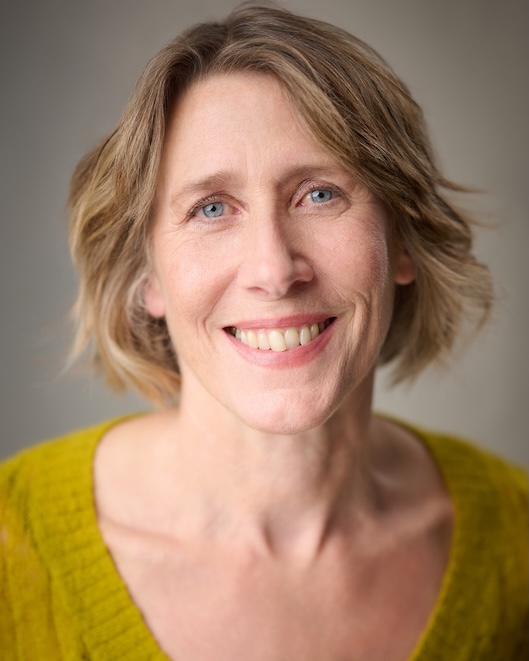
Tamsin Shasha is Artistic Director of Actors of Dionysus (aod) and an award-winning performer, writer and director. She trained at Oxford School of Drama, Ecole Philippe Gaulier and National Centre for Circus Arts. She joined Actors of Dionysus in 1993, after performing in their inaugural production of Hekabe (written and directed by David Stuttard) before establishing them as both a limited company in 1994 and registered charity in 1994. She has directed many productions for aod including Christopher Adams' futuristic version of Antigone, her self-penned Savage Beauty and Trojan Woman (adapted by David Stuttard). She has collaborated with leading theatre practitioners including Marcello Magni, Thea Nerissa-Barnes, Helen Tennison, John Nicholson and George Mann. Tamsin has also played many tragic and comic roles for the Actors of Dionysus company including Medea, Antigone, Dionysus and Lysistrata. More recently she is known for delivering the #DailyDose of Greek and Latin literature during the Covid lockdown. Tamsin is currently redeveloping a new semi biographical solo show called Forgive Me about autism, gaming and her own lately diagnosed ADHD.
This interview with Lorna Hardwick (Emerita Professor at The Open University and founder of Practitioners’ Voices in Classical Reception Studies) was conducted via email in the spring and summer of 2025.
A PDF transcript of this interview is available for download.
Lorna Hardwick: Can you tell us a little about how you first got involved with live theatre?
Tamsin Shasha: I’m trying to remember the very first time I ever acted on stage and I don’t have one of those ‘when I was ten I performed the role of ‘Annie’ moments’ but I always loved drama classes and I remember playing a working class Victorian girl in a play called The Laundry Girls (by Bill Owen) at secondary school and loving it. When I was about sixteen I joined a local amateur group in Ealing London called Questors Theatre and this is really where the theatre bug took hold. I relished those Saturday afternoons improvising scenes with others and performing in end of term scenes and shows. After I graduated from Newcastle with a History of Art degree I set up a community theatre company with a few friends called ‘Touch and Go’ and we toured schools in the North-East. Our first show was called The Peasants Revolt, which was about the first time the Poll Tax was introduced in England in 1381. We were touring this show in 1987 when the Thatcher government was preparing to introduce the Poll Tax – the slang name for The Community Charge, which was a tax levied per head, rather than based on income or property. This modern Poll Tax provoked considerable civil unrest and was subsequently replaced. ‘Touch and Go’ also toured Convicts, Lunatics and Women, which was about the Suffragette movement, so I was always interested in theatre with relevance and a political edge. We then took a children’s show about the Lambton Worm to the Edinburgh Fringe and performed outdoors on the Royal Mile and other locations and that was a baptism of fire and certainly nurtured resilience!
LH: And when did you first get interested in performing and directing Greek plays?
TS: I think my love affair with ancient Greek Drama began at school studying A-level Classical Civilization and reading Richard Lattimore’s translation of Homer’s Iliad, but it was Clytemnestra’s speech from Aeschylus’s Agamemnon that got me into drama school. Her speech to the Argive elders over the body of her dead husband Agamemnon, after she’d just butchered him was just too good to miss. That was well over thirty years ago now but I distinctly remember performing that speech at Oxford School of Drama and giving it my all and after that I never looked back. School had also introduced me to The Bacchae and Medea and so the work of Euripides became a firm favourite. There were only two of us in my state secondary school (Ellen Wilkinson School for Girls in Ealing, W5) who studied Class Civ and I looked forward to these classes more than any other.
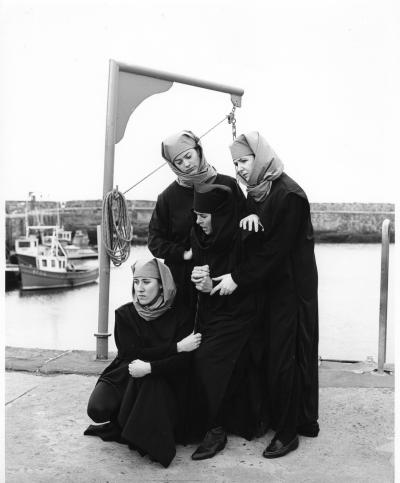
Years later I put my experience of Greek tragedy to the test when I performed in the chorus of the Actors of Dionysus’ first touring show, Hekabe, translated and directed by David Stuttard. Soon after I became Joint Artistic Director and I count myself lucky to have played such roles as Antigone, Medea, Lysistrata, Clytemnestra and Dionysus, before becoming interested in directing. Although I was classically trained at drama school I was always interested in physical theatre and retrained subsequently with Philippe Gaulier and also undertook many workshops including with Complicité (the groundbreaking theatre company and exponents of Jacque Le Coq’s teaching methods). This was while I was working with aod [Actors of Dionysus] and it gave me confidence to choreograph some of our own movement work. By that stage aod had worked with outside practitioners like Thea Nerissa Barnes (formerly at Phoenix Dance) and Marcello Magni (a founder member of Complicité) who worked with us on Medea and Antigone and Oedipus respectively and I learnt a lot from them. Sadly both of these heavyweights of dance and theatre have since passed away.
LH: What have been the main challenges and opportunities in working with Greek and Roman material? Have you any preferences between tragedy and comedy?
TS: aod has mostly staged ancient Greek drama, working predominantly with tragedy and only touched on Roman writing and poetry (during our #DailyDose lockdown series). I’ve played so many ancient Greek roles that I was given a nickname‘The Face of Tragedy’ by the Yorkshire Post (the company was based in York from 1995-2002) and the name stuck and was shortened to FoT! I would say one of many challenges of Greek tragedy is defining what the chorus is for a modern audience, especially when you are touring work with a small cast. We are known for our chamber versions of ancient Greek plays and for making the dramas accessible. When you are restricted in numbers you have to double roles (much like in ancient theatre where the maximum number of actors went from two to three, after Sophocles introduced the third), and you ask yourself ‘what function does the chorus perform here? How can a modern audience relate to them? How can they support the narrative?
For example in our version of Euripides’ Trojan Women, the main female characters (leaving aside the matriarch Hekabe) of Cassandra, Andromache and Helen, literally morph from the chorus to become strikingly different roles and then become a core of Trojan women who support their Queen again. The individual chorus members have their own personalities and journeys and this we found added to the tragedy and enabled the audience to go on an emotional journey with them also. Another challenge with the chorus is that they never directly affect the action, but they are there the whole time. Just them being there and not doing something therefore makes them in a sense complicit. In our aerial version of Medea for example we spent ages trying to work out how we incorporate the locking in and out of the aerial equipment as it was just technical business. In the end we decided to make it part of the action and not to try to hide it, but to use the chorus as if under Medea’s spell – i.e. being compelled by her.
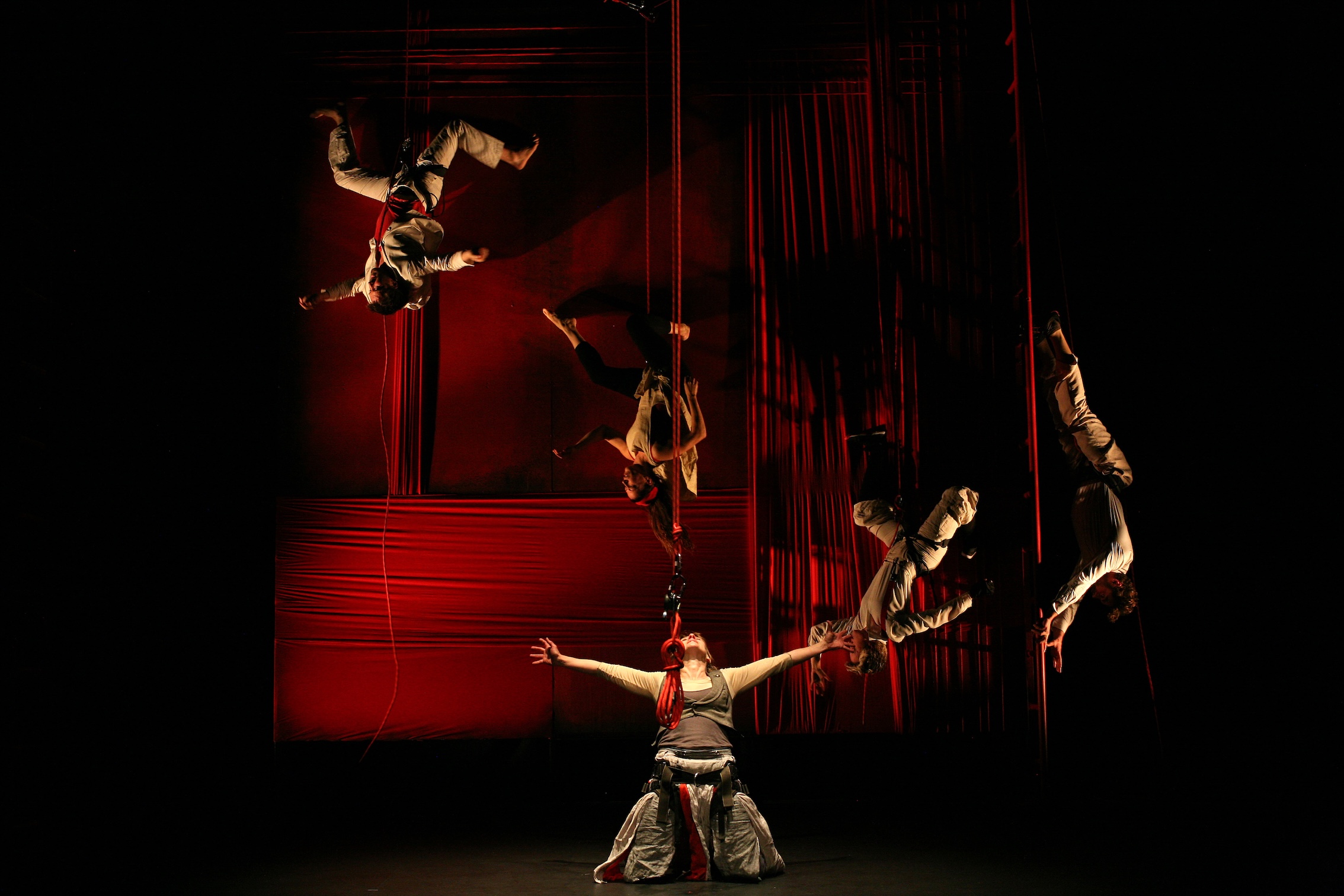
The deus ex machina presents another challenge – what does that mean for a modern audience? Gods in the Machine – what?! It presented a perfect opportunity in our aerial version of Medea, as the sorceress literally flew into the air above Jason suspended from a line vaulting her power and pre-eminence – a slightly more dramatic deus ex machina compared to our 1996 version when I used the strength in my knees and a ladder to mimic hydraulics behind a curtain!
Another challenge, and also opportunity, is finding the comedy in the tragedy, so that you can work the nuance in the storytelling and allow the audience to relax and, possibly, laugh before the final twist of the knife. You have to be bold in that respect so that you can plumb the depths of the tragedy. For example, there’s a scene in Oedipus where the old man appears at the end of the play and we worked with an actor who doubled as Creon and the Old Man and he really found the comedy in the latter role before Oedipus’s big reveal. It made that moment far more shocking than it would have been had we gone for the tragedy alone. It can be hard for an actor/director to find those moments and to be brave with them and not overly reverential. I also think that some performers think there’s a certain way to ‘perform’ Greek tragedy and I think that’s nonsense. We had an actor once who wanted to know how to do the ‘Greek walk’ and she behaved in a very mannered way. That’s because she had a preconceived notion about how to approach ancient Greek drama. It’s not our style to attempt to replicate an ancient acting style – comparatively little is known about it in any case – we just want to tell epic stories in interesting, compelling, and hopefully innovative, ways.
I’ve enjoyed working in both tragedy and comedy but I guess my natural disposition is toward tragedy. Having said that I really enjoyed playing the title role in Lysistrata for our 2010 national tour. Comedy is much harder than tragedy and having a funny bone helps and also collaborating with people around you who know what they’re doing. We worked with John Nicholson, formerly of the company Peepolykus and he worked on comic timing in the show, as did Toby Park (Spymonkey) who wrote the music. There was a slapstick/keystone cops element brought out by circus director Mitch Michelson which worked well in that interpretation and the audience seemed to love it, judging by the reviews.
I learnt so much on that show but it was a steep learning curve!
LH: Which roles and Greek/Roman authors have you most enjoyed?
TS: It would have to be Euripides – The Bacchae and Medea being two of the best plays, in my opinion, ever written, although I can see why Antigone is up there and lends itself to countless reinterpretations. Greek tragedy stands the test of time which is why so many writers, directors and theatre companies return to the source material again and again.
For me personally The Bacchae will always hold a very special place in my heart because that was the inspiration behind my first solo show, Bacchic working alongside theatre-maker Jonathan Young. It was a double challenge as the show had a very strong aerial/circus dimension – it was just me and a rope and a square of red fabric. I was a novice in circus but hungry to learn and I just loved that co-creative devising process using Euripides’ play as a starting point.
It seemed to me that the intrinsically epic nature of ancient Greek drama lent itself to aerial interpretation – the vertical line of the rope upwards became a connection to ‘the Gods’. In Bacchic this line was broken as our modern version of Dionysus became Suergaz (Zagreus backwards – an Orphic version of Dionysus) a mystic/rope guru with a huge fan base who suffers a massive fall from grace and struggles to regain his iconic status. Using rope skills and physicality we explored Suergaz’s power and influence and the effect he had on others, including the chorus. The rope was organically embedded in the show and used as the major prop throughout, not just aerially but as a phallus, a noose, a snake, a tea towel, a prison, etc. We spent many hours exploring its potentialities. Pentheus became a doubting academic by the name of Maddie, who only related to the rope domestically but became mesmerised and entranced by its power, lured toward her fate by our rope guru’s magnetism. Circus for me became a means to physically explore all of the philosophical elements in the play and the battle between science and religion, non-belief and idolotry. The show took me to the Edinburgh Fringe, throughout the UK and to an arts festival in Yerevan, Armenia.
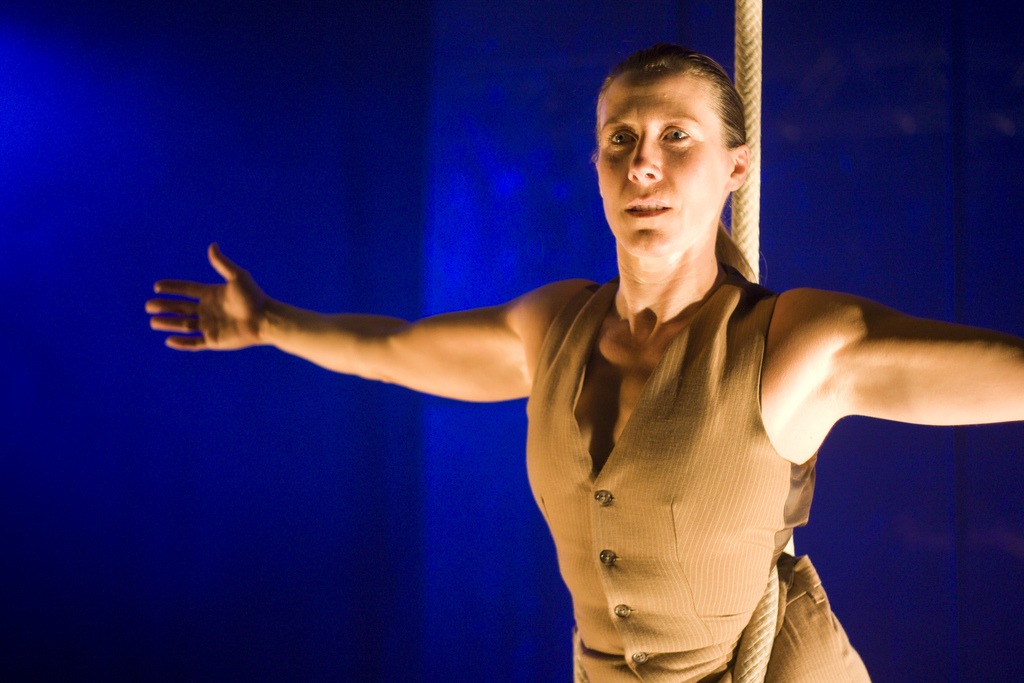
I have to say Medea is a close second. What a role for a woman and what a journey to go on! We’ve performed Medea several times in different versions and it’s always had its moments of epic drama (onstage and off!) but recording Medea for Penguin audiobooks in 1996 was a high point. Our aerial version of Medea took us even higher and was the most ambitious show we’d ever staged and a mammoth undertaking as I’ve already mentioned and will expand upon later.
I’m aiming to start work on a new solo called Hecuba’s Song at some stage on the future, working with incredibly talented and award-winning creatives Helen Tennison and Matt Eaton, which will take as its inspiration another of Euripides’ plays, Trojan Women.
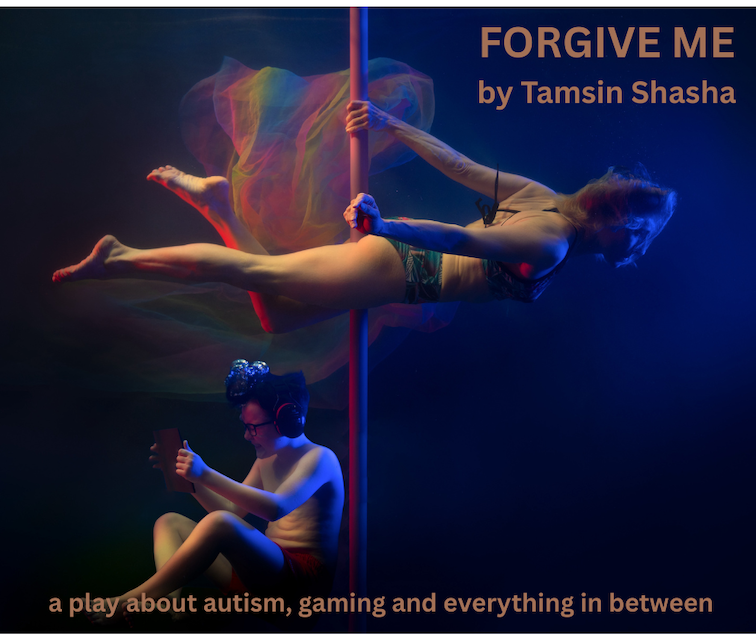
Another project I plan to return to is an autobiographical solo piece about my son’s autism and his love of gaming, called ‘Forgive Me’, which in future may contain a strong mythical aspect. Watch this space!
LH: Who are your main target audiences? Have your aims changed over the time you have been working with Actors of Dionysus?
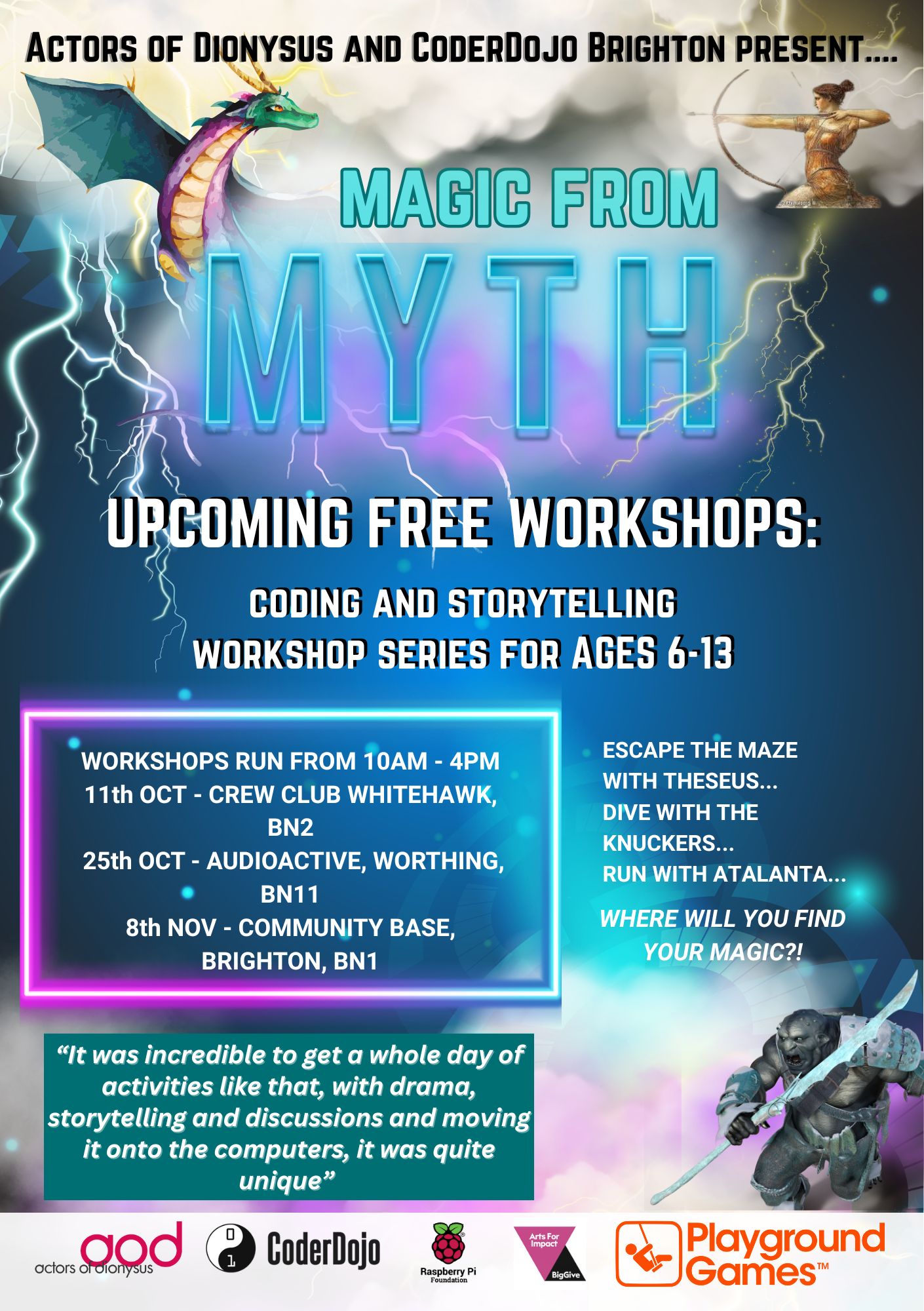
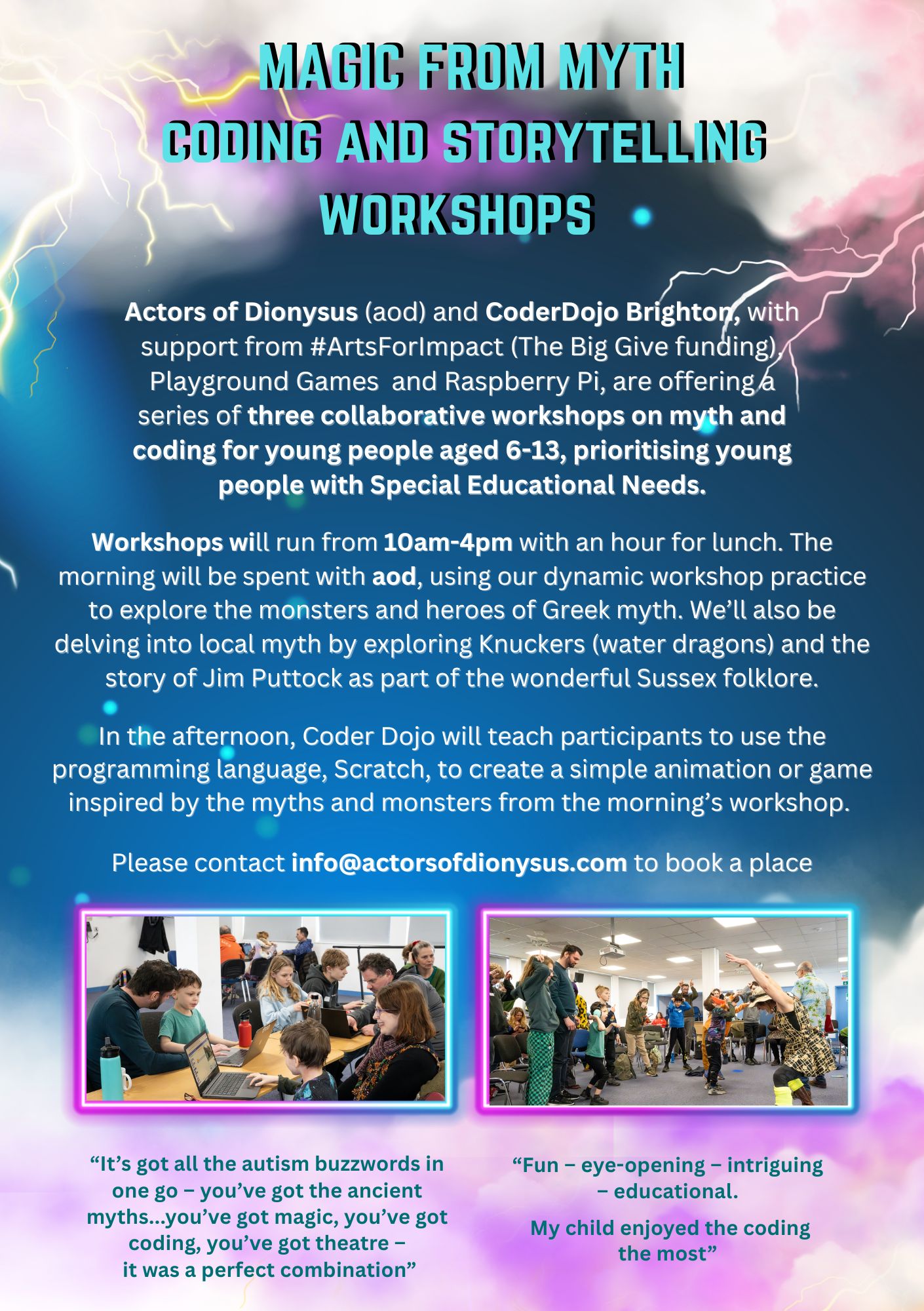
TS: Our main target audience has been, historically, young people aged sixteen to eighteen, supporting the school syllabus, but this demographic has changed over the years and our work appeals to older and younger audiences now. Generally it depends on what project we are working on any given time. For example we are currently developing a project called Magic from Myth Coding and Storytelling Workshops (in collaboration with the coding club Coder Dojo Brighton) designed to support young people age six to sixteen and prioritising those with special educational needs and from low socio-economic backgrounds. This is a relatively new project for us and responds to the technological world that we live in but also to my own experience of my son’s autism and his love of gaming. The coding element was a way to offer learning skills to young people but also access to Greek and local myth.
Another project that we introduced in the last five years is our Wonder Women of the Ancient World series (collaborating with Bee in my Beanie) for ages four to eight, revisiting myths and forgotten heroes, like Ariadne’s role in Cretan myth of Theseus and the Minotaur and Atalanta, the Amazonian huntress. Similarly with Black Voices in Myth we wanted to challenge the narrow window through which Classics is viewed and worked on two Research and Development projects over three years with this specific aim, ending with Andromeda and Other Black Icons, working with Dr Mai Musié, Leda Douglas and Ben Scheck.
Savage Beauty was a self-penned ecological version of Sophocles’ Antigone which we performed when lockdown briefly lifted in Oct 2020 and featured Leda Douglas with whom we continue to work with on Black Voices in Myth.
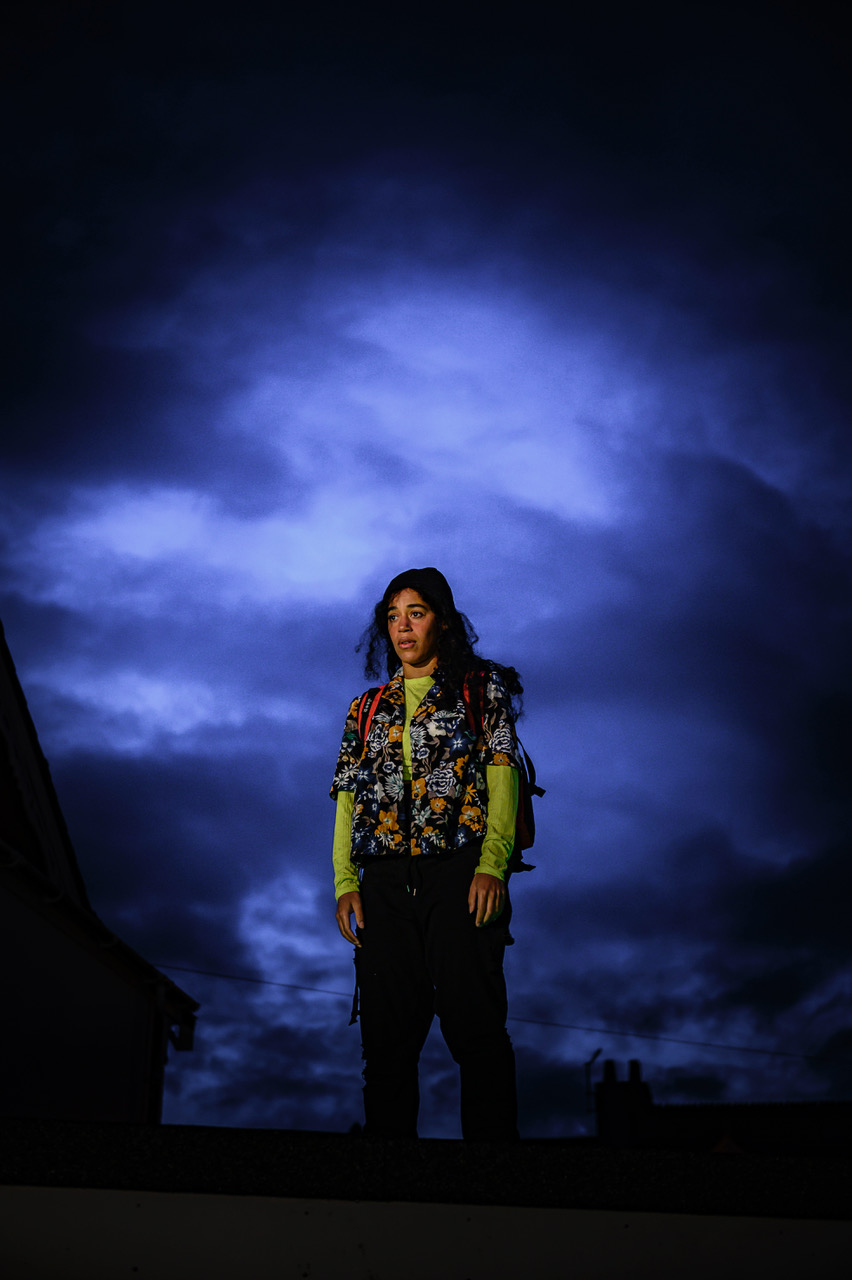
Hecuba’s Song, when I start developing it, will hopefully appeal to both schools and older audiences, and will be a radical reworking of Euripides’ Trojan Women.
These are examples of five projects that wouldn’t have occurred to us in the nineties or noughties, because our aim at that time was to provide young people, specifically sixteen to eighteen year olds, with live theatre that responded directly to the schools GCSE A-level set texts (for Class Civ and Drama) to support student learning. Not being regularly funded, this kind of schools touring (mostly in private schools it has to be said!) was our bread and butter and what kept us going, but gradually I began to programme national tours to a mixture of larger mainstream venues like Brighton Dome, Bath and York Theatre Royal as well as smaller Arts Centres, universities and school theatres. We haven’t toured in that way since Covid because the cultural sector has never fully recovered and reduced income from touring means the figures just do not add up. Covid lockdown led us to create a new digital arm to our work called #DailyDose (now #MiniMyth) which delivered daily online content via social media platforms. This project ran consecutively for eighteen months including an online Digital Dionysia festival over three consecutive days during the Coronavirus pandemic and most content is available via our YouTube channel.
The other thing I was keen to do was expand our work in state schools by offering free drama workshops to those with less access and this is something I am passionate about developing and something that we continued in 2024/25 with our Magic from Myth Coding and Storytelling Workshops. our educational outreach work is key to our values and core mission and we are hoping to expand our workshop programme nationally. We are also exploring a new idea of a Teachers and Educators Network to support the teaching of Drama and Classics, offering both a practical and academic forum to support schools and college. Added to this a local (Sussex) Family Arts Network (with Family Arts Campaign), a resource-sharing network designed to extend the offer to families focusing on specific regional knowledge and sharing insights, resources and skills. All of these ideas take time and money but they are concrete aspirations that we are working toward.
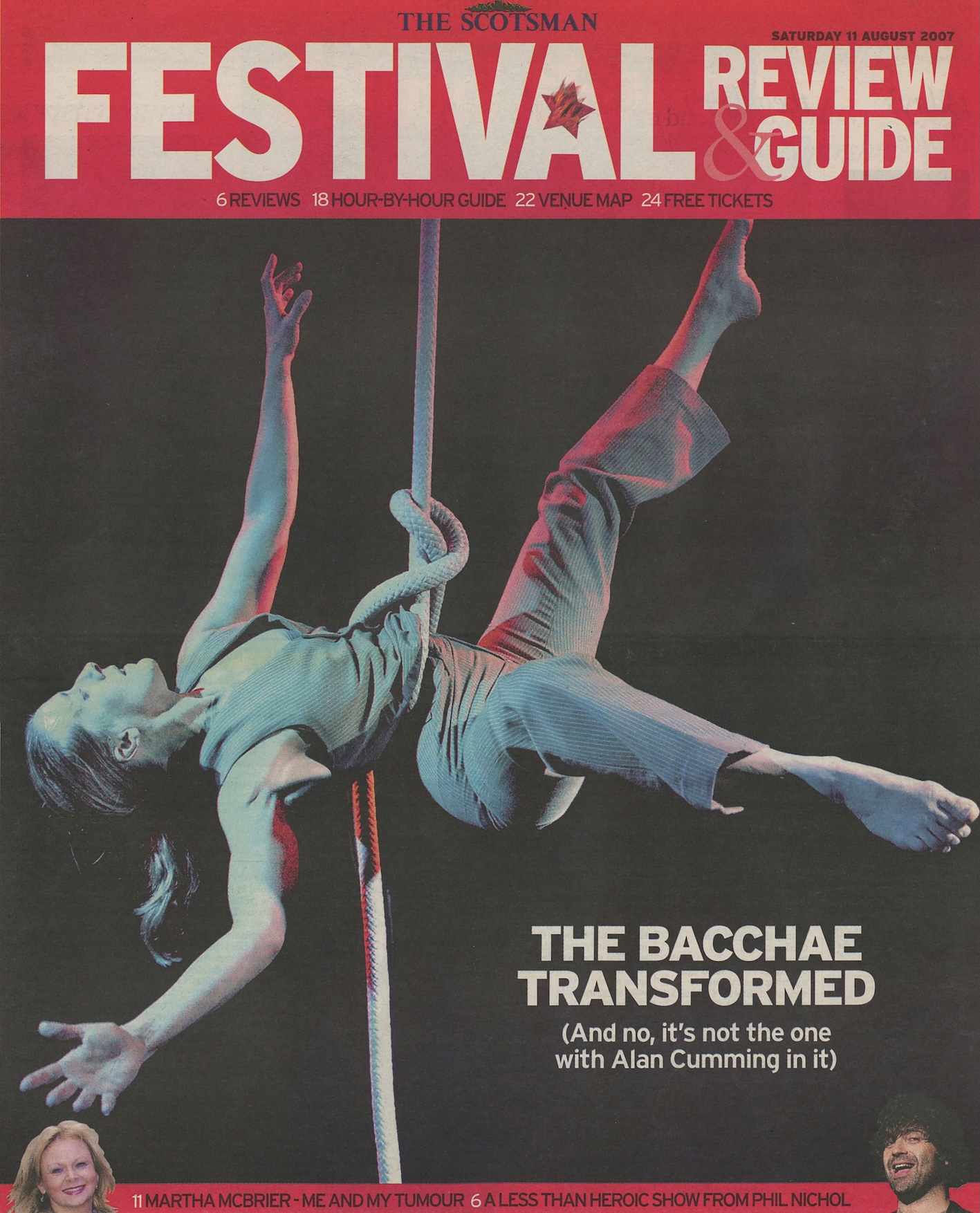
On a personal level my own interests in circus, devising and new writing meant we veered in a new direction. This led to the creation of exciting collaborative opportunities beginning with Bacchic (2006), which lent itself to a younger, more alternative demographic. Performing at the Edinburgh Fringe with the show and being selected for an international showcase called Caravan in 2008, consolidated this new (and circus) strand of our work and our work abroad. This trend continued with Medea in 2013 and Helen in 2014, although the former had an educational tie in which helped significantly with audience sales!
My own freelance solo work also developed this circus strand and in 2018 I conceived. produced and co-wrote an aerial two-hander called Everything I See I Swallow, which I took to Edinburgh Fringe (where it won a Fringe First) and on national tour. I am currently exploring the second stage of another physical theatre piece using pole to explore an autobiographical solo piece about autism and gaming called Forgive Me which may be redeveloped with aod.
LH: You perform the ancient plays and adaptions in English translation. How does that affect your use of the ancient theatre conventions such as the chorus, as well as your rehearsal techniques and sound and movement in the acting spaces?
TS: Well, as much as we’re aware of the conventions of staging Greek drama, as I mentioned, we don’t attempt to replicate them, but we will use techniques which support or magnify a dramatic moment or dynamic. We don’t have the luxury of having a Greek chorus of the size that would have performed in Epidavros (with twelve to fifteen members) but we do our best with a total cast size of five on average (Antigone 2017; Lysistrata 2016; Medea 2013) – chamber versions of ancient Greek drama! It’s all relative, of course, and five seems profligate when you’re devising a solo show with you playing all the parts. In my solo show Bacchic, I had a chorus of three characters and I switched between them and the two main protagonists, which was challenging when you’re often five metres above the ground dangling from a rope…..but it’s possible!
In terms of exercises, we tend to play a lot during rehearsal, working with things like Lecoq’s Levels of Tension, ensemble games including le jeu, working on status, tableaux, rhythm, choral flow and improv challenges. I also like hot seating characters once the cast are familiar with their roles. It makes performers think about where their characters have been, where they’re going, what makes them tick, etc.
We have often worked with a voice and movement coach depending on the challenges of the play and I find that singing is a natural glue for ensemble work, whether or not you’re actually singing in the show! I love singing and recently finished a stint in the community choir at Glyndebourne in a new opera called Uprising. I appreciate how much singing practice can help with forward placement in the mouth - it gets the resonators going and wakes up the voice ready for the hefty text work that ancient Greek drama demands. All of that juicy stichomythia!
These exercises are not exhaustive and depending on my own development and any new workshop skills I may have picked up I might incorporate new ideas and challenges, eg incorporating elements of Viewpoints, for example, based on a workshop I attended led by Helen Tennison and inspired by the teaching of dancer-choreographer Mary Overlie and later developed by Anne Bogart and Tina Landau. Most recently I completed a weekend intensive on Clown and Dark Clown with the inimitable Peta Lily with a view to working on Hecuba’s Song and also redeveloping Forgive Me.
LH: In the last few years, you have acquired a reputation for innovation in blending physical theatre into Greek plays – including circus skills and rope work (corde lisse). Could you tell us what this has involved, and especially how you trained for it?
TS: The physical theatre element was there long before the circus dimension, but the two are interlinked because when we toured with Bacchae in 2000 the set was a dynamic metal cage, that could be swung and climbed on. Essentially it was a playground, and I loved it! It gave me carte blanche to be physical. I opened the play with Dionysus’s speech hanging from one arm and then proceeded to dance and swing around the set. One of the reviews mentioned my acrobatic circus skills. I hadn’t trained then, but it planted a seed in my mind. Soon after, I saw a piece of aerial theatre on tissu (silks) and that was it – I fell in love. As with anything you see, you feel compelled to challenge yourself and although it felt a bit late in life to run away with the circus, it was a ‘never say never’ moment!
I trained initially at the National Centre for Circus Arts (Circus Space when I was there) and subsequently in Brighton. The training involved lessons in trapeze, silks and corde lisse and I soon developed calloused hands (my hands will never feature in an ad for Palmolive!) …but as my core started to get stronger I became more confident. I loved being in the air and the feeling of weightlessness and particularly the liminal space hovering above the ground, where anything could potentially happen. The vertical line represented something spiritual to me (as I’ve already mentioned) and very soon I started to think of other organic ways to incorporate circus into Greek tragic narratives, things like the rope being a stairway to immortality and what happens when that line is broken, as in Bacchic. How a set of red silks would become the dress for Helen of Troy, how different fabrics and silks could potentially ensnare her like a web, as in our aerial show Helen. The epic possibilities were immense.
My solo aerial show, Bacchic, came soon after and Jonathan Young (my director and co-devisor) and I worked hard to create a dynamic narrative in which the circus element truly justified itself. This was quite a rigorous process, analysing the original and creating a modern adaptation (as indicated above) and involved playing in the space with the rope and making artistic offers, with crash mat at hand! We filmed and transcribed a lot of this material and the best of it went in the show. The original R&D had a working title, From the Beast to the Blonde (inspired by Marina Warner’s book) and I was planning to explore female icons, including Helen of Troy but my fascination with Dionysus won me over in the end!
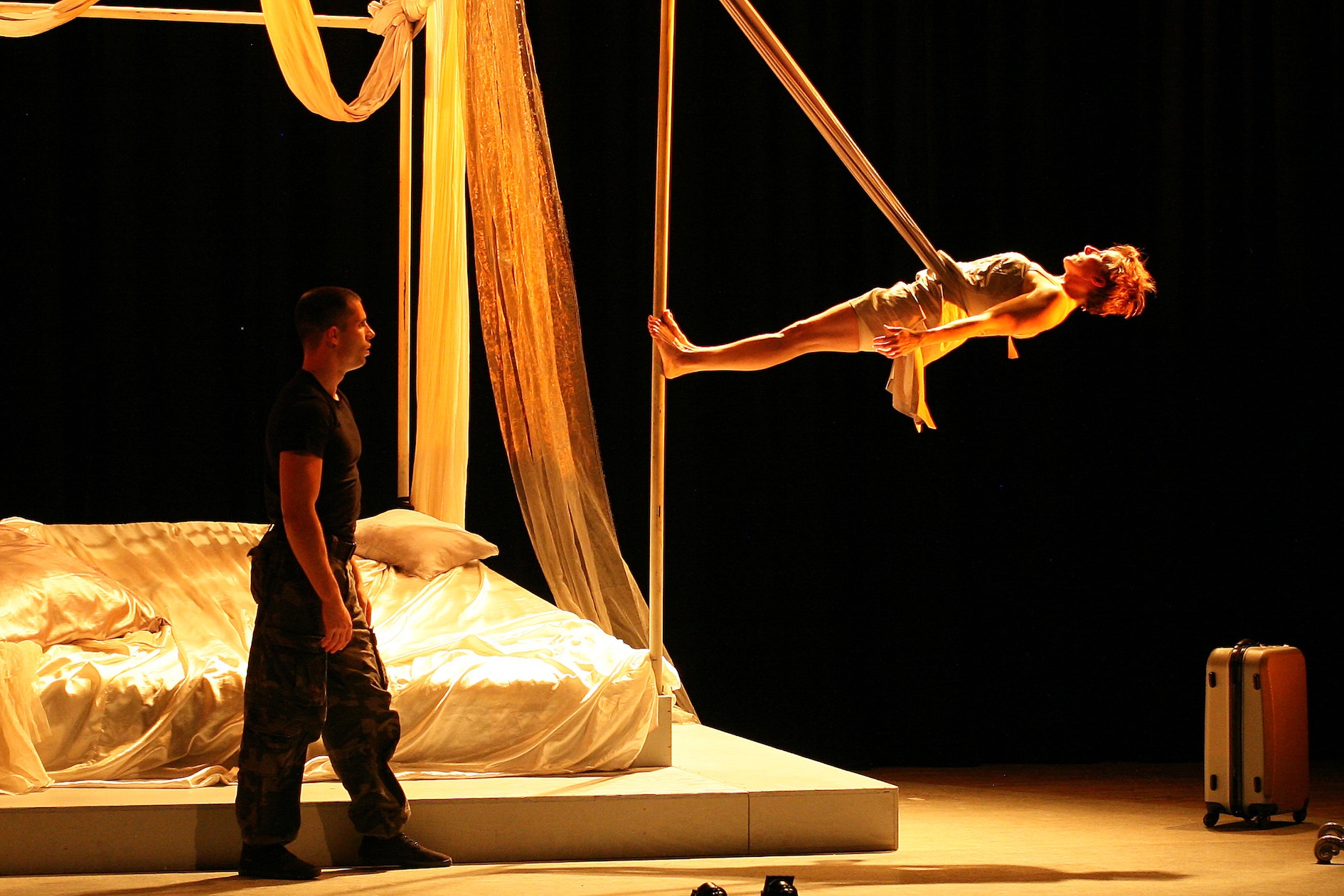
Helen (of Troy) became the subject and title of my next aerial excursion, a two-hander and skewed love story, which involved an oversized four-poster bed (designed by the late and inimitable Dora Schweitzer) as its centrepiece, and here we used silks draped from the top of the bed as an aerial playground. This created a much softer, more feminine backdrop that was gradually stripped back to reveal an old woman, vulnerable and isolated, the scars from her latest cosmetic surgery plain to see. A woman so in love with the myth of herself that she refuses to acknowledge her mortality. The silks added layers of texture that gave a false sense of comfort. We gradually see that she is being held in a prison of her own making. The silks became a spider’s web that capture and torment her, until she realises that her beauty is finite.
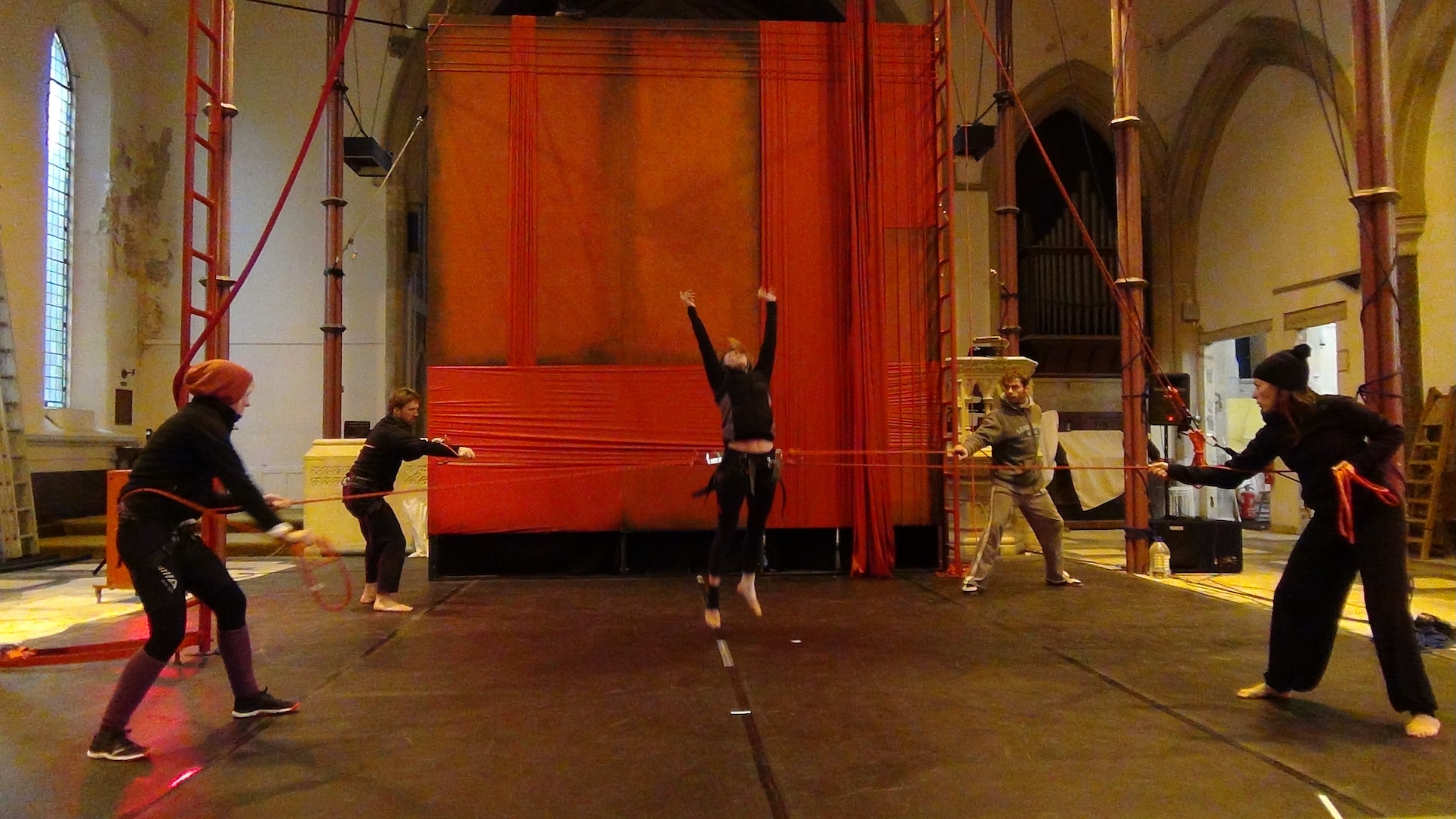
Medea was by far the most ambitious aerial drama that I have embarked on and involved new aspects of aerial training in harnesses. I took courses with Lindsey Butcher at the European Aerial Dance Festival (EADF) in aerial counterweight, counterbalance and vertical dance and all five cast members trained with aerial specialist Jami Reed-Quarrell. We had a week at Rose Theatre Kingston and our set (also designed by Dora Schweitzer) was a huge red wall that formed the backdrop to the action but also an aerial playground. The impetus being an aerial investigation of this tragedy derived from Medea’s supernatural/witchcraft powers and the deus ex machina (as I have already mentioned). At the end of the play Medea, as sorceress, literally flew above Jason, vaulting her power and pre-eminence. Her status as granddaughter to Helios the Sun God proudly exhibited in all its glory. The five-strong cast were in harnesses the whole time, working both on and off the four by five metre wall. We rehearsed in a freezing cold church in winter (not exactly conducive to circus work) and we had a rocket heater which attempted to take the chill out of the air with little success. We also worked with Anna Porubcansky, an amazing singing coach and I loved the Georgian and Corsican songs that she brought to the table, which really propelled the epic nature of the tragedy.
LH: Can you tell us about your development from actor to director to writer and how these activities link together (or not)?
TS: My interest was always in the physical potential of the narratives and how the drama could be enhanced by movement. I started working as aod’s Movement designer, looking specifically at chorus interaction. In 1999 I ran a summer workshop with students in Palea Epidavros and had the luxury of working with around twenty students on the Bacchae and slightly smaller numbers on Electra and Antigone. I loved the opportunity to play that this presented, having a larger chorus and took what I’d learnt from the students back into aod’s touring work, specifically Euripides’ Electra. From thereon I began to explore the symbolic, psychological and metaphorical opportunities that the chorus presented. I spent ages listening to film soundtracks and contacted composers Jocelyn Pook and Max Richter who allowed me to use some of their music. This was like gold dust and helped me to play with movement and choreography of the chorus scenes. It seemed like a natural progression from actor to movement director to director in that respect. I worked as co-director with Marcello Magni on a version of our Oedipus. It was an incredibly challenging process, largely to do with clashing egos, but I learnt a lot and then went back to the play and directed it on my own. I loved the freedom to do that and the confidence it gave me.
I think that may have been the seed to start creating and devising my own work, but my instinctive nature is always to collaborate. Although I wrote our 2020 version of Antigone (Savage Beauty) on my own, I rarely have the confidence to write solely in my own space. I am a pragmatist and an ideas person and I tend to come up with innovative options for new work, like our Magic from Myth Coding and Storytelling Workshops, our aerial interpretation of Medea, the concept of Everything I See I Swallow (which combined rope bondage and intergenerational feminism). Having the confidence, self-discipline (and time to put aside!) to write something on my own is rare, but something I’d like to nurture. What I find is that bouncing ideas off other people and playing with them in a space generates new pathways of artistic opportunity. Sound and music often inspire me to as do other creative prompts. For example if I’m devising in a room with my sound designer, Matt Eaton he’ll be working away quietly in the background, conjuring ideas and will then come up with an auditory banger that might take me in another creative direction or lend another dimension to the piece. Similarly I like to work with directors who can throw things at you (sometimes literally!) and you have to respond in the moment. When I worked with Helen Tennison on the early stages of research and development of Forgive Me she would offer creative nuggets for exploration and I would run with them. It’s at that moment when you come out of your comfort zone that you can really take artistic risk. Similarly when I was devising with Jonathan Young, working on Bacchic or Helen, we would roughly plot the structure of the drama and then I would improvise scenes based on suggested ideas. We would record and transcribe the process with the best bits edited into the finished piece, whilst most of it would end up on the cutting room floor. Collaborating in this way makes the whole process far more satisfying and rounded. So in this way, a solo is never really a solo – it’s inspired by the creativity in the room and the electricity of ideas around you. I know that some people (e.g. David William Bryan who runs solo masterclass courses online) like to work truly solo (whatever that means, because you always need someone to Outside Eye your work) but for me collaboration is key and makes for a far richer process, more enjoyable and I would suggest a more three-dimensional outcome. I like to feel challenged and thereby enriched by the creative process. I also find it hard to work in a vacuum. It’s part of the stimulus that informs my decision to work in the arts and I think I need the impetus that other people/energies bring. The proof of the pudding of course is in the eating so whatever your method it’s the end product that matters and if your strength is working tout seul and you can deliver the goods then so be it.
LH: Although aod has its own base, you tour extensively. How does this affect creation and preparation of performance, rehearsals, scenery, props, adaptation to different acting spaces?
TS: aod doesn’t have its own theatre as such, although we have been using our house and garden (award-winning LIONHOUSE venue at Brighton Fringe) as a performance space since 2020. Not having a purpose-built theatre or rehearsal space has meant that we often have to hire outside space including church halls, community centres, other theatres, etc. There have been many occasions in the past where a school or theatre has supported or co-commissioned our work, as in the Lowry, Rose Theatre Kingston, the Castle in Wellingborough or Bradfield College and that has made a huge difference to us as it has meant that rehearsal and tech time is often provided for free in exchange for a performance/workshop package. In the majority of occasions, we have had to rent suitable spaces and we factor that into our budget. Although we have been touring to both small and mid-scale venues our sets are designed in such a way that they are adaptable to different spaces, can fit into a long wheelbase van and can easily be assembled on the day of the performance, so that we are able to ‘get in’ and perform on the same day. We prepare a technical tour pack or rider and risk assessment which is sent to all venues in advance of booking to ensure that our touring show will fit into their space and this would include a list of minimum requirements, including things like stage dimensions, rake, lighting rig, audience capacity, etc. If a show has an aerial dimension that obviously has to be factored in and load tested beams or rigging points need to be available. It helps if the space is warm as rehearsing any physical/aerial work in arctic conditions (as I mentioned above) is not ideal but sometimes needs must!
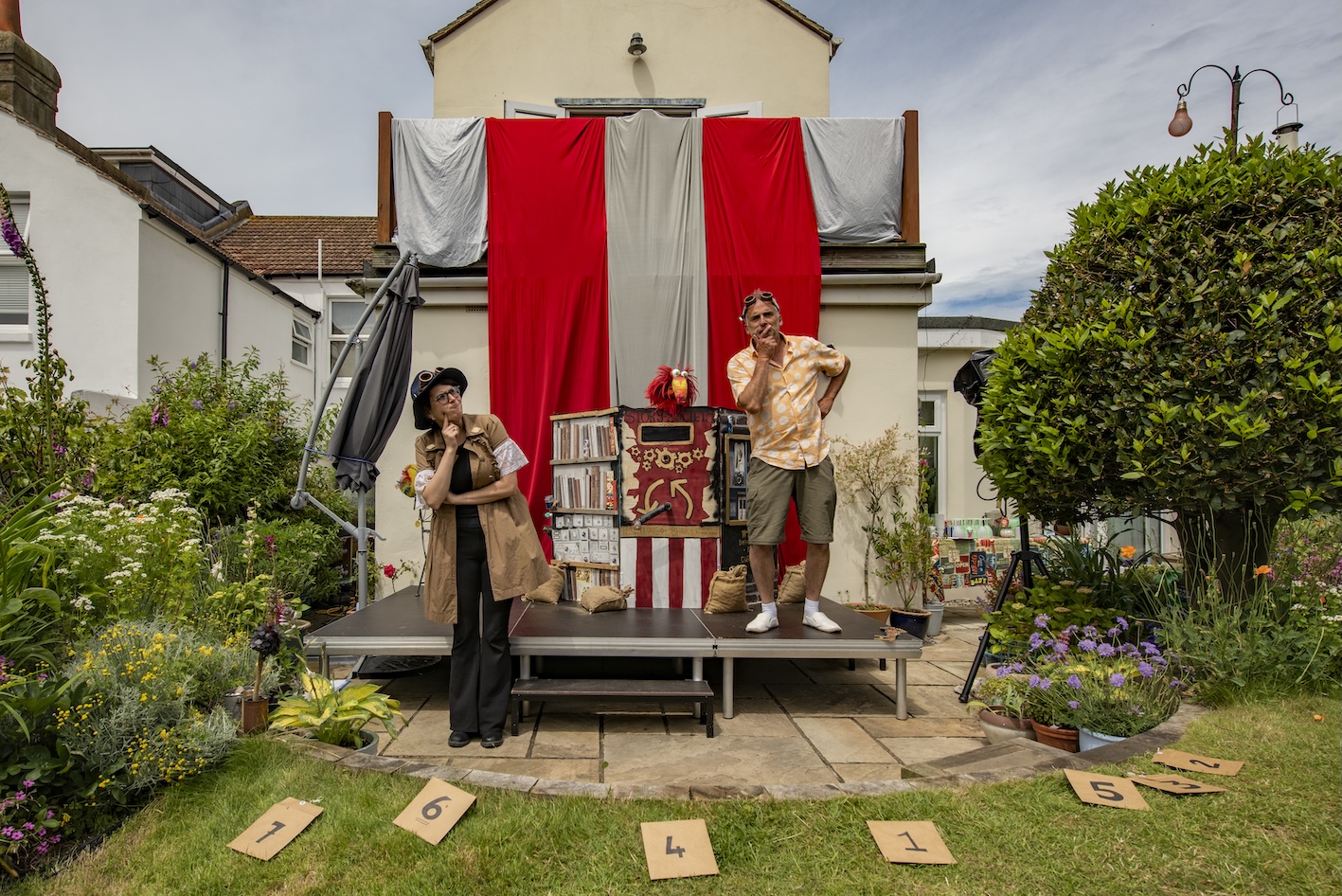
Recently we’ve been expanding the output we produce at our LIONHOUSE venue in May. Our garden space can seat around forty, and as an outdoor space you are at the mercy of the weather and need to be prepared for what Old Blighty throws at you. Our children’s show series Wonder Women of the Ancient World performed in all weathers and does involve a bit of careful adaptation if the heavens descend. Electronic equipment moves indoors, the giant water pistol becomes slightly redundant, but the umbrellas create a colourful backdrop! Having said that we’ve just had the most glorious May festival and our Arias in the Garden performed against gloriously balmy weather.
LH: Live theatre generally has faced problems in the last few years – pandemic and lockdown; changes in schools and colleges which have reduced the time available for the performing arts; cost of living crisis; rising energy costs - and much more! Which issues have impacted on your work the most and how have you addressed them?
TS: It’s a challenging profession and we have had our ups and downs financially and artistically, like any other cultural organisation, venue or charity. As a purely project funded non-profit organisation (ie not a regularly funded National Portfolio Organisation) it can be hand to mouth. I think our strength is our resilience and the experience of having weathered many economic downturns including the crash in 2008, but also prior to that the financial repercussions from Black Wednesday’s sterling crash of 1992 and the obvious cost of living crisis that we are currently experiencing (worsened by Brexit, which has severely damaged both the cultural sector and the UK’s wider international collaboration).
Not being regularly funded has meant that we have had to be resourceful in maintaining operation by exploring alternative funding avenues and actively seeking philanthropic opportunities. Like many other arts charities we set up an annual Friends Membership scheme called Friends of Dionysus, which consisted of three types of membership: Friends (FoDs, £45), Patrons (PoDs £250) and Benefactors (BoDs £1000+). We were optimistic in adding a fourth more rarefied tier of God of Dionysus (GoD £5000+) years later!
Our charitable status has allowed us to claim Gift Aid and Creative Tax Relief - a lifeline on numerous occasions. In 2012 we set up an informal events arm of the company called aod. Events specifically designed to raise funds for specific projects and core costs. This involved organising one-off special events and gala performances in the homes of wealthy benefactors willing to share their homes and guest lists. It was quite a lot of work in the planning and execution as we would have to organise the catering, send out invitations, arrange auctions and prizes. We ran this project for five consecutive years, generating income and expanding our database of wealthier supporters, but the actual performance event eventually ran its course for various reasons, including Brexit.
This income generating stream has been replaced with online campaigns like the Big Give, which sometimes yield significant support especially if they are genuinely ‘Double your Support’ schemes, when donations are matched by a specific trust or sponsor. Our recent #ArtsForImpact appeal via the Big Give helped to raise money to expand our Magic from Myth Coding and Storytelling Workshops, for example. We also put together one-off fund-raising events promoted to our Members (detailed above) when the need is there and a specific project needs targeted support.
Another way of saving, as opposed to generating, funds has been in terms of office rental. Although we’ve rented office space in the past (as when we relocated to Brighton from York) we’ve gravitated toward working from home and more remote working. This has positives in that you’re saving on rent, but negatives in terms of sometimes feeling isolated. Generally I enjoy choosing where and when I work and not feeling guilty that I don’t go into ‘the office’. Our freelance staff work remotely too and I try to mix it up, sometimes factoring in funding for hot desking and office space as and when we need.
The Covid pandemic was extremely challenging, but we were lucky to gain a Cultural Recovery grant from the Arts Council which allowed us to keep going. We adapted our work online, offering free workshops and resources including free streaming of our productions to schools and the general public. We also ran an online series called #DailyDose (which became #MiniMyth) which offered regular digital content and ran online festivals featuring a wide variety of contributors including Stephen Fry, Edith Hall, Natalie Haynes and Mary Beard, plus many actors, singers, circus performers and dancers.
The fallout from Covid 19 is still being felt though with audience figures not remotely back to what they were. That combined with the cost-of-living crisis has undoubtedly led to theatres closing, freelance artists and the arts in general struggling. We haven’t ourselves embarked on a national tour since before the pandemic, because venue guarantees have reduced despite inflation and fees have gone up, so the figures just do not make economic sense. Audiences are also more erratic, tend to book much later which is nerve wracking for producers. The recent proposed governmental changes to disability allowance has set those artists with more need on edge and added unnecessary stress and anxiety. Now more than ever we need those who have the means to support the Arts to step up to the plate and dig deep into their pockets. The Creative Industries are worth £124 billion to the UK economy and worth investing in. Live art can be a great leveller and can benefit everyone, especially those with less privilege and especially at times of great economic and political upheaval like now. We need the Arts to stimulate, educate and inspire and also hold those in power to account.
LH: What are your current ambitions for the future – in terms of your own artistic development? And in terms of how you can contribute to the importance of live theatre and the performing arts for young people as well as in society more generally?
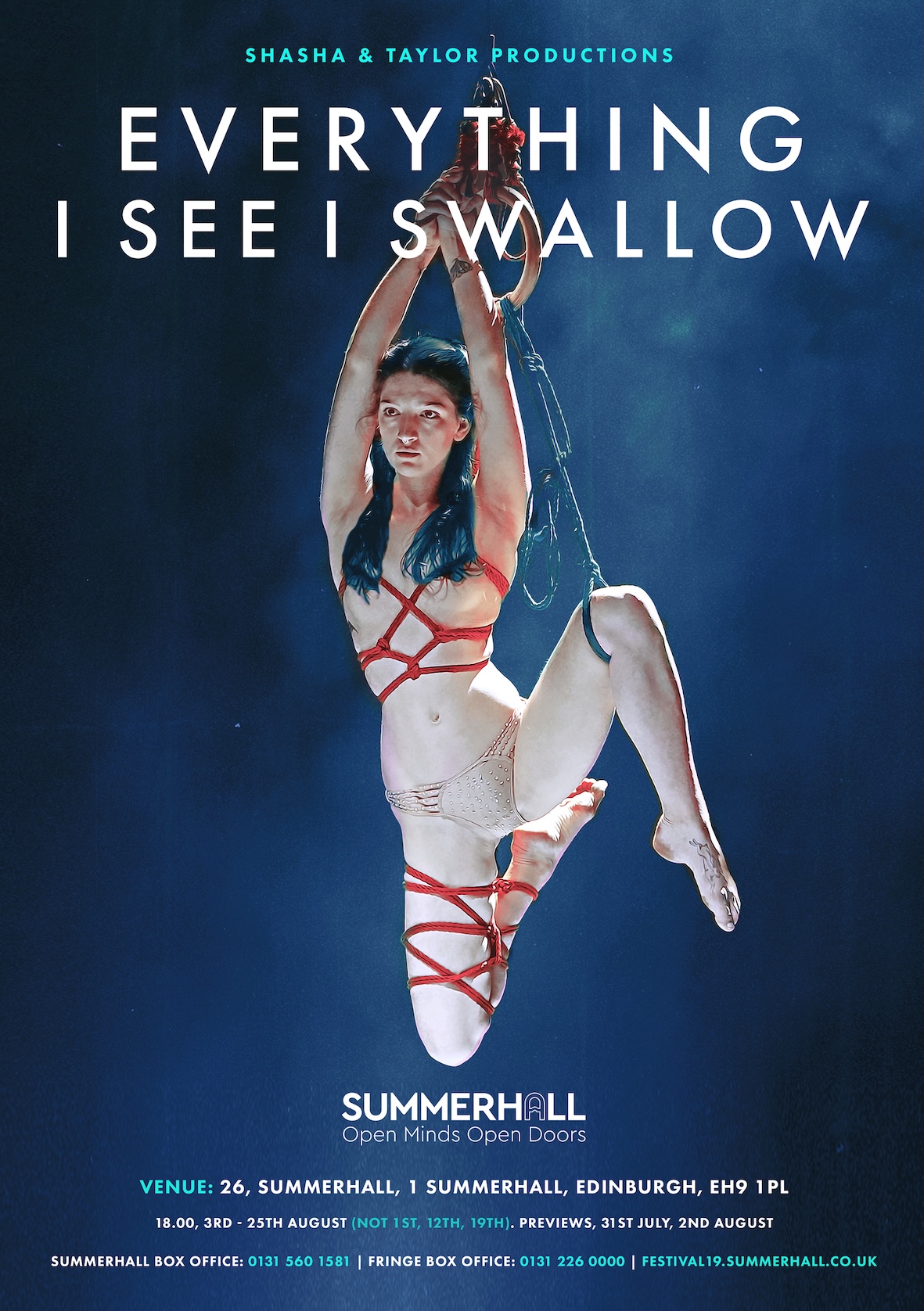
TS: As well as working for aod I am a freelance theatre-maker and I often have other projects simmering away in the back of my head. As I mentioned earlier I produced, co-wrote and performed in the aerial two hander Everything I See I Swallow in 2019 collaborating with Maisy Taylor and Helen Tennison. The project was originally commissioned by the Lowry for their Week53 festival. The show explored intergenerational feminism and rope bondage – a bit different from my mythical work! This allowed time away from aod and we took the show to Summerhall at Edinburgh Fringe where it won a Fringe First for innovation. Following on from that I developed another devised new writing project called Forgive Me, also with director Helen Tennison. This is at the second stage of research and development and is an autobiographical project based on my son’s diagnosis of autism and his love of gaming. This latter project (which featured animation and live interactive gaming) is both deeply personal and extremely ambitious and one of my aims is to finish it! A very recent diagnosis of ADHD has added another layer of navigation to this project, which I aim to integrate as honestly as I can. The diagnosis has explained a lot of things to me and why I often take on far too many projects in one go and have difficulty finishing them! Forgive Me is a project that’s very close to my heart and my wish is for it to bring greater understanding of and empathy for neurodiversity in all its forms. In such a vastly shifting political and ecological landscape what is normal after all? If Forgive Me can support the SEND community in any way whatsoever then I have done my job.
Circuitously Forgive Me led aod in a more digital direction with our Magic from Myth Coding and Storytelling Workshop series (highlighted earlier) which is ongoing and which we’ve recently raised #ArtsForImpact (Big Give) funding for further development. This project prioritises young people with additonal needs and combines access to ancient myth with practical coding skills, encouraging young people to include storytelling in their digital animation and to use myth as inspiration. I am very passionate about this project because it opens doors for young people who may not otherwise have access to ancient Greek myth whilst also providing an outlet for their creativity. The project came about after the discovery of a fortnightly coding club in Brighton called Coder Dojo which my son began to regularly attend. I started a conversation with the club who were very keen to support the project, as were the Raspberry Pi Foundation who donated laptops specifically for our collaboration.
As a seasoned theatre-maker I have lived through many social, political and economic shifts a no more so than now. Responding to the negative and divisive effects of Brexit I co-founded a grassroots company and CIC (Community Interest Company) called Festival of Europe aimed at healing the social and cultural divide caused by the UK’s decision to leave the EU. I designed the website and helped to organise many cultural events which celebrated our connection to the rest of Europe. The project is operational but currently dormant, my voluntary capacity being stretched to the limit, but I remain passionate about projects that heal cultural and intergenerational divides and encourage conversations about important and pressing issues. Creatively I’m coming back to where I started in terms of relevance and responding to the here and now. What started with Convicts, Lunatics and Women continues via a myriad of projects with aod onward to Forgive Me, the Magic from Myth Storytelling and Coding Workshops and Hecuba’s Song, projects which respond to community interests and the technological changes we see around us. Of course everyone needs escapism from time to time and light-hearted musicals can be fun but there needs to be ongoing support and space for risk takers and challenging work - new writing that pushes the boundaries, especially at a time when the authoritarian suppression of artists is on the rise.
I think we need the arts to be enshrined into our education system and too often it’s seen as an add on, being slowly undermined by successive governments and people like Michael Gove who favour STEM subjects. Storytelling is at the heart of what we do as theatre-makers and we are duty bound to create work that encourages critical thinking and makes you question perceived wisdom especially the ‘alternate facts’ that are constantly being thrown at us. With that in mind I am interested in making work that encourages young people to stand up and listen, work that includes them in the conversation, like our Magic from Myth Coding and Storytelling Workshops. Work like Everything I See I Swallow which encourages people to have conversations about what it is to be a feminist and a woman and to listen to opposing views. Forgive Me which explores a mother’s understanding of her son’s autism and his love of gaming and how the two might connect. Work that encourages intergenerational discussion. Work that is inclusive and accessible. Work that interrogates history and asks questions.
I feel like I’ve travelled some way, but I have an endless journey ahead of me………
Find out more…


Explore

Undergraduate
Postgraduate
Policy
-
Follow us on Social media
-


