
Márcia Limma
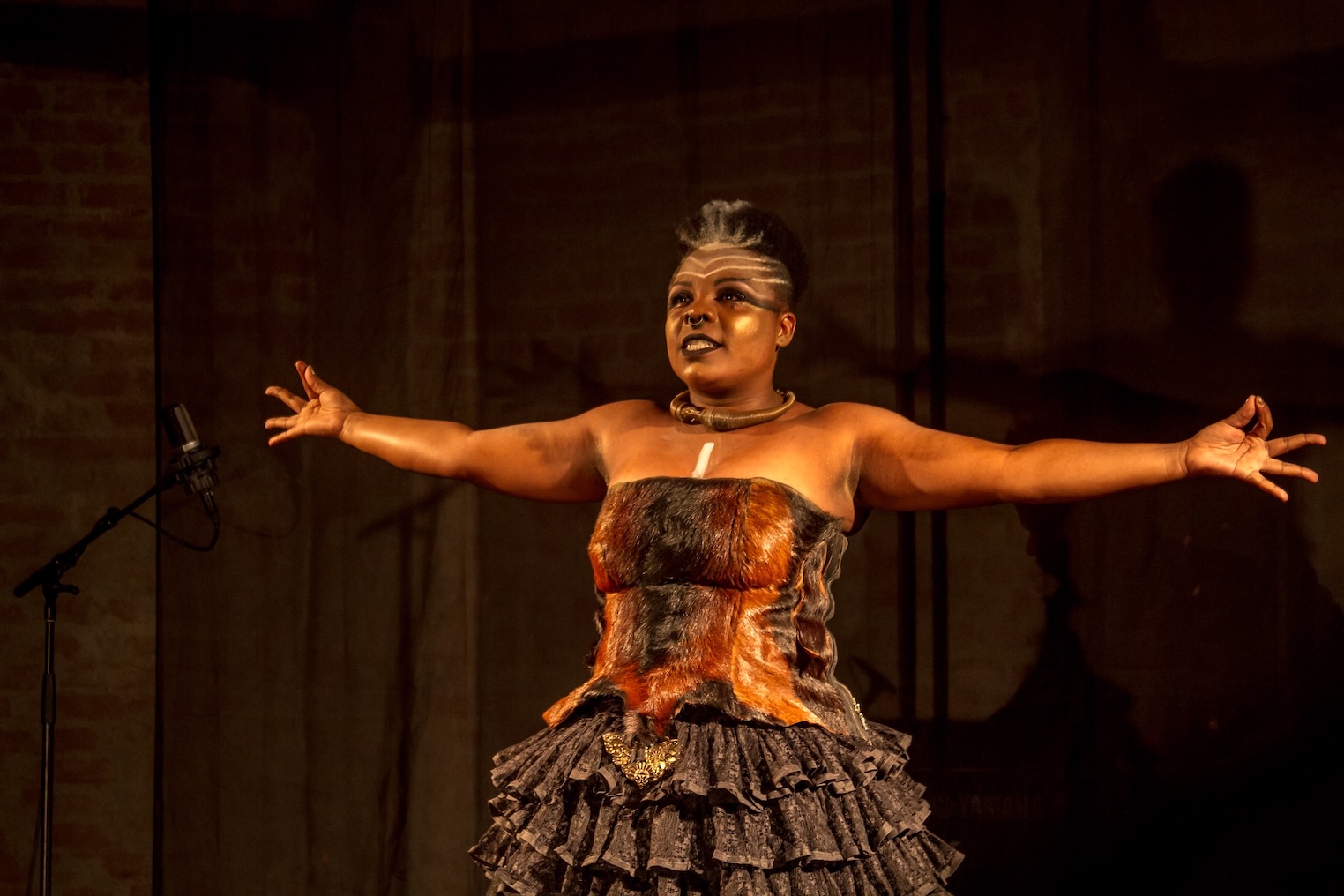
Márcia Limma is an award-winning actress, singer and cultural producer. She has a Masters in Performing Arts from the Federal University of Bahia (Brazil), and her professional career spans over two decades. She is a founder member of Brazilian theatre group Grupo Vilavox, and has collaborated with a number of other important Brazilian collectives and directors.
Médeia Negra (‘Black Medea’) is a 2019 solo performance that was made in Brazil and subsequently staged worldwide. Márcia Limma played the solo and produced the performance together with Márcio Maciano, Daniel Arcades and Tânia Farias. In this interview, Limma explains how the performance uses the ancient Greek figure of Medea to discuss the social difficulties and hardships facing black women in contemporary Brazil. She also discusses how her performance fuses Medea with many Afro-Brazilian elements, such as the ‘orixás’, spiritual figures living in the human world, which were part of a religious practice that arrived in South America from West Africa via the transatlantic slave trade.
This interview was conducted in Portuguese by Larissa Lemos and edited by Maarten De Pourcq. The performance is available in its entirety on YouTube.
Larissa Lemos: You did your theatrical training in Brazil, at the Escola de Teatro da Universidade Federal da Bahia. As far as I know, this training was very Eurocentric, so how did Greek tragedy figure in it? Did you like working with Greek tragedy?
Márcia Limma: I have always been in love with Greek tragedy. I found the verses and the words, difficult as they are, also a joy to pronounce – so uncommon. Every tragic character has something of an exaggeration that challenges the player to seek new ways of expression. My passion for theatre exists precisely because theatre allows me to exaggerate. That’s why I chose to work with tragedies as often as possible in theatre school.
In 2009 our teachers made us perform Euripides’ Medea. That’s when it all started. Also my initial discomfort with Euripides. In those days there wasn’t much talk about feminism at the university, but it was exactly what bothered me about Euripides’ version. As if he had been paid by the Athenian authorities to deconstruct the older image of Medea as a wise sorceress. He turned her into a demon who kills her own children out of love. That is quite an exaggeration. More than from Euripides’ Medea, my Medea was born out of that discomfort with Euripides. So although I love Greek tragedy, I still see the need to decolonise the classics. To bring them to other bodies, other ways of thinking and speaking. This is one way of rebelling against that universalism of the classics, as if there is only one right way of thinking. So my fellow students and I wanted to thoroughly change that patriarchal version of Euripides, but our drama teachers didn’t go along with us: ‘No, you’re here to perform a classic. Do your experiment later.’ And so that’s what I did: I made another Medea ten years later, a Medea who had to say that she’s black. I did that because people didn’t see that she is black, even though she is black. If you don’t say it, people don’t see it, so I had to say it.

LL: Your 2019 solo, however, does fit into a rich tradition of black Medeas in Brazil and in the Americas, you were not the first to stage a black Medea.
ML: I didn’t learn about these at theatre school at all. For instance, Além do Rio (Medea) [Beyond the River (Medea)], written by Agostinho Olavo [in 1957], had no place in our curriculum, although it is a Brazilian drama classic.
LL: In your solo, you mix traditions: for example, Greek tragedy with candomblé, which also happens in Além do Rio. Can you tell us a bit more about the creative process behind such decisions?
ML: For me, Medea comes down to choosing who you are. For me, this is closely related to the question of magic, or spirituality. When in Além do Rio, which takes place in Brazil, the local laundresses condemn the former African queen Medea because of her candomblé, it is reminiscent of the colonial Catholics who believed that the devil and therefore evil was worshipped in candomblé. But for me, there is no good or evil, people are both good and evil at the same time. All negative judgments about women who call themselves sorceresses or witches stem from the patriarchy that wants to curtail women’s power. For centuries, women have cultivated their power though sorcery. Sorcery is a feminine practice of healing, being in touch with nature and your ancestors. Women need those encounters with female ancestors, because those ancestors have already overcome obstacles in their lives, they have managed to heal themselves and others, they have followed their own path and stood up to patriarchy.
In Além do Rio, Medea is colonised and decolonised. Even when she has become a mother of blonde Brazilian boys, the drums of nature call to her incessantly, saying: ‘You are a queen. You should not make yourself smaller because of your husband. You are powerful, a queen. You don’t have to be a slave.’ When I bring the candomblé into Médeia Negra, it’s not so much about religion as it is about energy: that women can draw strength from their ancestors. If you have an orixá, you have the power to transform yourself. For example, in my play Medea has Iansã, the orixá of wind, which allows her to become a lightweight like a butterfly and also a roaring bull who can defend herself. This is what I want women to see, especially women who are in prison because of violence: that the force is with them, that they are not alone, that they descend from women who have already fought against patriarchy through spirituality, like Medea. She makes us understand our inner strength.
LL: When and why did you decide to work with Medea again, ten years after your first adaptation at theatre school?
ML: It didn’t actually have anything directly to do with Medea. I was creating the play Castelo da Torre (2015), playing an enslaved person trapped in the cellars of the Garcia d’Avila castle in Bahia. The Garcia d’Avila family used to dominate the slave trade in the Northeast of Brazil and decimated the indigenous population, forcing them to bring more and more slaves here. Working with that shackled body, the sensation of Medea came very strongly to my mind, the sensation of a black woman rebelling: against her owner, against the religion and God that were imposed on her as a prisoner. This is also when the idea of working with women who are in prison today was born.
So I started giving workshops in prisons in which I shared with women the story of Medea. They immediately recognised themselves in her. They saw that Medea was a woman burdened by a system. They were all in prison because of a husband, mostly because they dealt drugs to get money while their partner was unemployed and often asked them to deal drugs themselves. Many of them had no father, like me, and were abandoned by their families once they were in prison. Many had experienced violence from what we in Brazil call ‘machismo’: when only men matter. Often these women were in the wrong place at the wrong time. The violence that arose in them as a result of these workshops! My God, how much I learned in that prison. Medea was a heroine to them. It was important for me to show them this archetype of a woman who rebels and rebuilds her life. Because she overcomes in the end. Medea possesses the power of language, she is a strategist in survival and possesses a lot of self-knowledge – at least, that is what I believe. That gave strength to those women in prison.
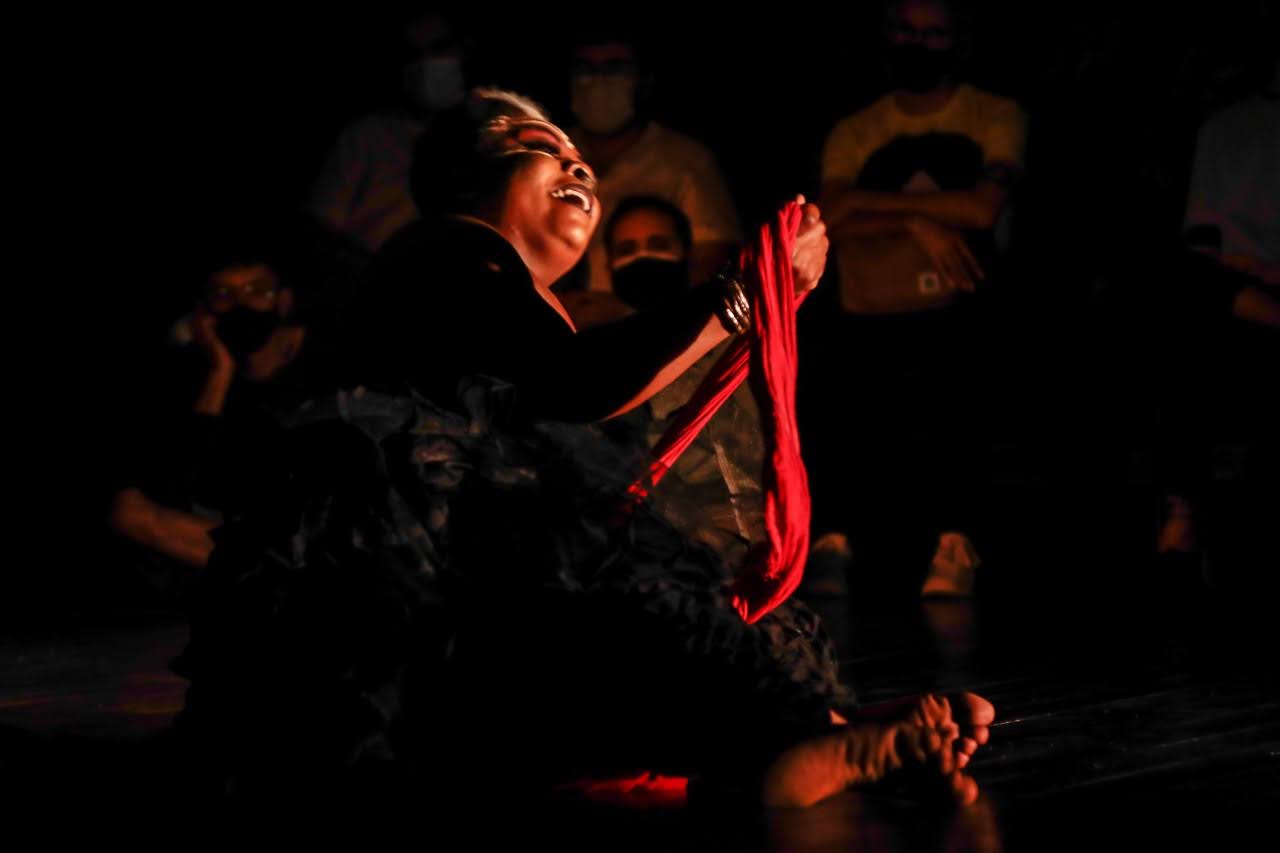
They attended the premiere of Médeia Negra in Salvador and you could see that they had changed after the performance. Their attitude was completely different. Instead of letting themselves be made small, they knew they could be someone else, someone like Medea, a winner. There were also many other women who came to thank me after the performance, with tears in their eyes. They recognised every word of it. Some men think my Medea is too much of an avenger, but there are also men who have come to tell me that they have begun to look differently at how they treat women.
LL: You also performed your solo in Europe. How did audiences react there?
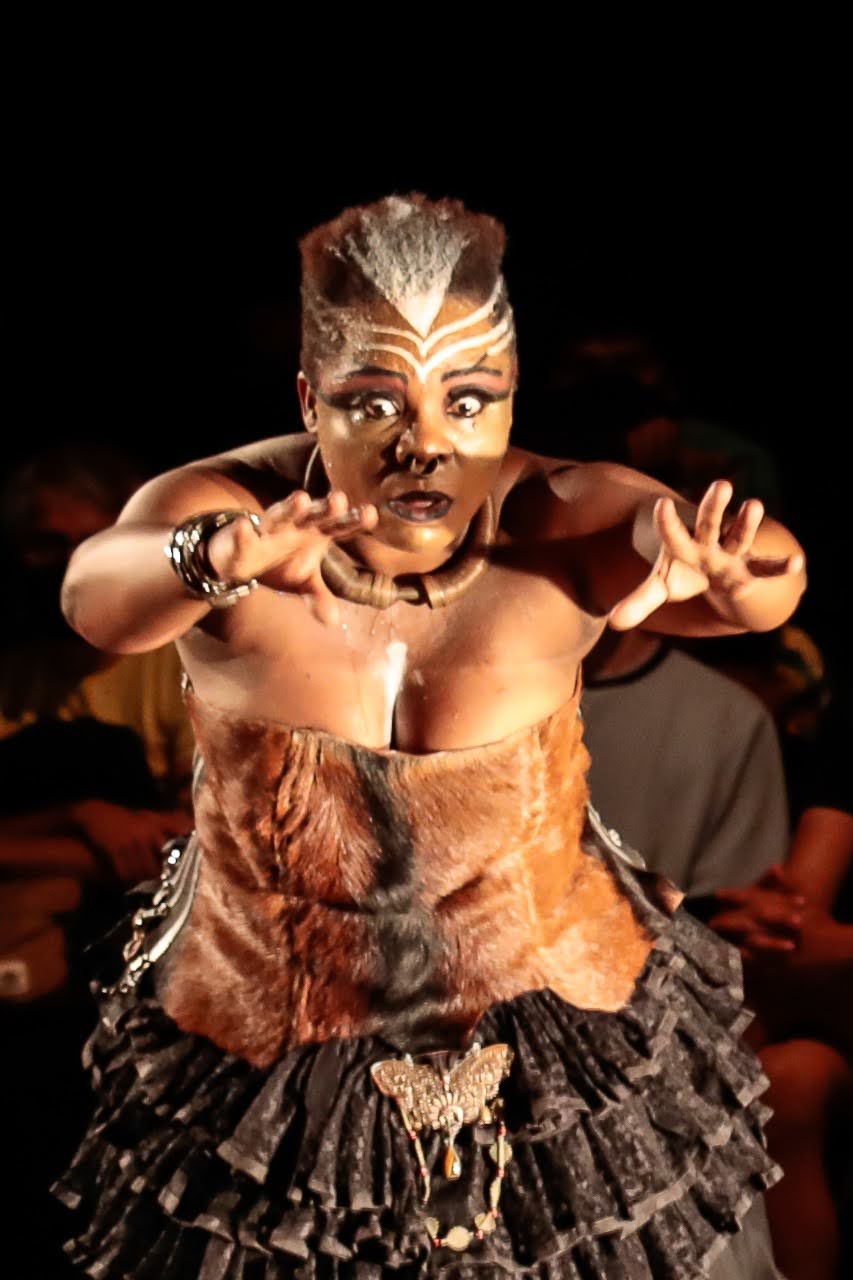
ML: (laughs) ‘This is not Medea,’ said a woman during an after-talk. I was shocked: folks, how can this not be Medea? But then when you look at the context: I was in Germany, I was doing something with a classic of theirs, or what they think is theirs. It’s very uncomfortable for them to see a black woman standing in the centre saying she’s Medea. But I do what I want. I do what I want (laughs). It is also a mix. There’s the Greek background, there’s the African background. I wanted to get a form of Afro-futurism into the body of Medea, so that when she walks across the stage and talks about past, present and future, we are left wondering what kind of figure she really is. After all, she is not human. She is a goddess. She has the talent to transform herself, to start over – no, not to start over, but to transform into whatever she wants herself to be. The makeup and clothes show this: the presence of present, past and future in one place. Being on earth, being a god herself and not running away from Euripides. When I was thinking during the preparation about how to justify Medea’s infanticide, something Euripides invented, I was reminded of the body of that black woman who, like me, has a choice: either bear children or become someone, go to college, for example, because you can’t do both at the same time. At least: that is how my family history was, and do I want to repeat it? Having a child and then working hard as a domestic help to support the child, because fathers don’t take responsibility. I lived all my life in the favela and there I saw twelve-year-old boys being killed, girls addicted to drugs, crying mothers. I felt I did not deserve that. So I decided not to have children, to become a theatre maker. So Medea is also Márcia Limma.


Explore

Undergraduate
Postgraduate
Policy
-
Follow us on Social media
-


