
What has the European Convention on Human Rights ever done for us?
This blog was written by Emily Geer (final year law student at the Open University law school).
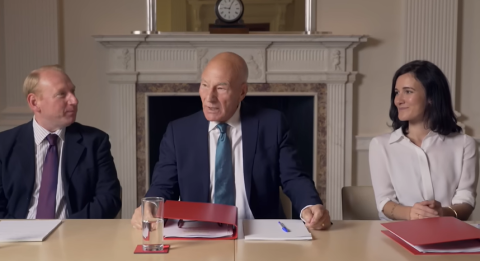
It has been several years since the broadcasting of Sir Patrick Stewart’s amusing comedy sketch titled ‘What has the European Convention on Human Rights ever done for us?’ For those who have not watched the sketch (I would highly recommend it), Sir Patrick Stewart playing the UK Prime Minister has a round table meeting with his ministers to discuss his negative view of the ECHR. This is where he says the famous line “What has the European Convention on Human Rights ever done for us?” Taking it in turns, his Ministers nervously remind him of all the rights that are protected under the ECHR. He begins to be persuaded of the ECHR’s usefulness but demands he wants it to be written by the British not the Europeans. He is then awkwardly corrected by one of his Ministers that the ECHR is in fact written by us! This comment causes Sir Patrick Stewart’s character to explode in frustration, which is of great amusement to the audience, and ends the sketch. Although it has been several years since the sketch was made, the topic of the ECHR is still causing controversy today. As we strive into a new parliamentary session, with ECHR dismantlement rife on government lips, it might be worth reflecting again on what the ECHR has done for us.
As explained in the comedy sketch, the ECHR was drafted, mainly by British lawyers, 75 years ago after WWII. It was aimed at protecting peace and individual rights. And 25 years ago, the UK introduced human rights into its domestic law through the enactment of the Human Rights Act 1998. In a recent article in the Law Society Gazette, Fiona Scolding KC (2025) explains, amongst other things, that 80% of the current UK population have lived their whole lives with justiciable human rights. The rights provide a set of guarantees to life, such as prevention of slavery, freedom of thought and right to marry, to name just a few. Her article raises a number of interesting points about the ECHR.
Just like in the comedy sketch, our current Prime Minister (Sir Keir Starmer), has put the ECHR under intense political scrutiny. This is after identifying concerns with how the ECHR/HRA is applied to immigration cases. He believes they need to be ‘updated’ and ‘refreshed’. However, as amending parts of an international convention would take a great deal of time, this has led to other politicians wanting the UK to simply leave the ECHR. Yet, this would cause government issues with other parts of our international relationships such as trade. (Fiona Scolding KC (2025).
Immigration is the ignition to most talk of dismantling/leaving the ECHR. Article 3 in particular (prevention of inhumane and degrading treatment) is the most controversial in immigration cases. Examples include stories of immigrants who have been convicted of crimes in the UK unable to be sent back to their countries, because those in ill health will not receive the same health services as provided by the UK if they were returned. Even though the UK Supreme Court has limited these circumstances of no return, some think that it is not enough. (Fiona Scolding KC (2025).
Fiona Scolding KC (2025) believes it is the role of lawyers working with human rights to give good reason why human rights matter for individuals and for the continuation of peace with the other countries in the convention. For instance, a positive about the ECHR is that it gives a framework that enables scrutiny of the legality of decision making by using proportionality. For example, Article 5 (right to liberty and security) safeguards those who live in residential care and allows consideration of whether restrictions on their lives are proportionate. It is also important to note that there are cases outside of immigration where the ECHR has been used and publicised. For instance, Article 2 (right to life) means that the courts can examine failures in policing or other state errors leading to the violent deaths or suicides of members of the public. Another is Article 8 (right to respect for private and family life) that ensures the right to privacy from unnecessary press intrusion. With regards to how much influence the ECHR has over the UK, only 0.19% of the European Court of Human Right’s case load in 2023 was from the UK. This evidence shows that the European Court of Human Rights has not intervened that much with UK cases. (Fiona Scolding KC (2025).
In a climate of dissatisfaction with political choices, fear and uncertainty it is tempting to dismantle a 75-year-old convention that can be perceived as no longer working for us. However, there is an argument that because of the ECHR we have lived in Europe largely conflict free for the past 75 years and it has enabled the evolution of other international law. (Fiona Scolding KC (2025).
Perhaps it is time for another round table meeting to discuss. Apart from the right to a fair trial, the right to privacy, freedom from torture and degrading treatment, freedom of religion, freedom of expression, freedom from discrimination, freedom from slavery, protecting victims of domestic violence, and peace in Northern Ireland, what has the ECHR ever done for us?
Reference list
Fiona Scolding KC (2025) ‘Conventional Wisdom’ Law Society Gazette, 5 December 2025 edition.
Available at: https://edition.pagesuite.com/html5/reader/production/default.aspx?pubname=&edid=81914972-be7d-49f6-be74-52c68d08b8e9
(Accessed 21 December 2025).
Mentioned: Patrick Stewart sketch: what has the ECHR ever done for us?
Available at: https://www.youtube.com/watch?v=ptfmAY6M6aA
(Accessed 21 December 2025).


Explore

Undergraduate
Postgraduate
Policy
-
Follow us on Social media
-


