
The Christmas Story: A Time of Reflection
This final blog of the 'Legally Christmas' series is written by Senior Lecturer in Law, Emma Curryer. Emma is using an interdisciplinary approach to research, considering the association between criminal justice, Egyptology, archaeology, and literature.
At this time of year, as we approach Christmas, I am reminded of the Christmas story and the first European archaeologists in Egypt who often based their digging around areas that they thought were linked to the bible, seeking evidence of events such as the exodus and the Pharoah who was king of Egypt at the time.
However, I am reminded of much more than that, of the hopes and dreams of different people in different cultures all over the world, but particularly those of women whose voices can sometimes be overlooked.
At a recent cross-cultural event in Cairo in Egypt, the presentations that were given were thought provoking, eclectic and diverse. Everything from information on Ancient Egypt to connections between Ancient Egypt and Ireland, Nubia, Avaris, France, Persia, the Mediterranean, America and beyond. The hopes and dreams of different people in different cultures in history all over the world, but particularly those of women whose voices can sometimes be overlooked, echoed in the lecture theatre. It was an opportunity to meet and collaborate with a cross-cultural community and consider interaction at its best.
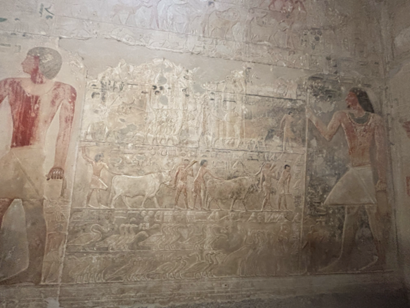
(image: Tomb of Ptahhotep II, Saqqara, Dynasty 5, 2414 – 2378BCE displaying farming scenes)
The presentation I gave on female archaeologists and travellers in Egypt in the early to mid-twentieth century attempted to show how they not only shaped our view of Egypt and Egyptian society, but how Egypt’s society and people shaped them.
Throughout the 5,000 years plus of Egyptian history the role of women has been ever evolving and impacted by religion and society, but through it all the strand that continues in Egypt today is a pride of the past and a zest for life in the here and now. We could all learn from that.
There is no doubt that we are all touched by the past, present and future. A society’s social and political history is complicated, and many people have fed into Egypt’s modern age and how Ancient Egypt is viewed.
The conference caused me to think of how the impact of Egypt, and my own society has shaped the research that I do around justice and what justice means to different societies and individuals.
One of the women I spoke about was Agatha Christie. I can almost hear you say how is she relevant to the story of Egypt or justice? She is because of the subtle impact that her writing has on the individuals that read her books, let’s not forget she is the most sold female author of all time, she was also an archaeologist who spent much of her time working on archaeological sites in the Near East, particularly what is now modern-day Syria and Iraq
Agatha Christie is better known for her crime fiction which includes her views on justice. These views transcend many of her books as does her knowledge of ancient Egypt and the Near East.
Death Comes as the End is a 20th century novel, written toward the end of the second world war but based in the Middle Kingdom in Ancient Egypt, around 2000 years BCE. At its heart is Agatha’s unique technique of being able to transport the reader to another place and time. Alright, so you might not want to actually go there when I tell you there is a serial killer at large, but all ends well and is that not the point of the Christmas story of hope for the future?
In the Author ‘s note to the book, Agatha tells us that the inspiration for the characters and plot came from Egyptian letters written some 3,000 odd years ago in the 11th Dynasty in Egypt. She was referring to the Hekanakht papyri which was a selection of letters from a Ka priest to his family. They read almost as if they could have been written today and include instructions on what his family should do while he is away. What is so compelling about the book is that when you read it you could be in Egypt 2,000 years BCE. In part, this is due to Agatha’s eye for detail and her archaeological background. She researched the period well by continually reading, studying the past and continually calling and asking her friend Stephen Glanville, a leading archaeologist at the time, questions about ordinary daily life in order to be able to write authoritatively about the period. It seems to me that this eye to detail allowed her to appreciate cross cultural traits common to us all.
I won’t ruin the book for you but the thread that runs through it is that justice will be done. The plot centres around family life and what happens when jealousy takes over. After several members of the family die, the killer meets an untimely death and the ancient Egypt sense of Maat, a concept embracing the theory of justice, balance and order is restored.
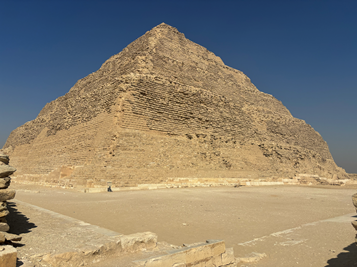
Whilst some of the ways that Agatha deals with characters is problematic if we view her work through a 21st century lens, the impact of her novels, and adaptations for television and the cinema cannot be overstated. Who hasn’t seen Death on the Nile and wanted to be transported to Egypt and the pyramids? The pyramids whose story was there long before the Christmas one.
Indeed, many twentieth century travellers went to Egypt encouraged by scenes from Agatha’s books and travelled on the SS Sudan and visited the Old Cataract Hotel in Aswan, both of which she used to write Death on the Nile.
One thing that is common through time, is that for a society to prosper there must be justice and that justice is shaped by the society of the day. Justice is the common thread that transcends time and place. Agatha so beautifully portrays that in her work.
In the words of Hori from Death Comes as the End (Christie, A,)
“It is so easy and it costs so little labour to write down ten bushells of barley, or a hundred head of cattle, or ten fields of spelt – and the thing that is written will come to seem like the real thing, and so the writer and the scribe will come to despise the man who ploughs the fields and reaps the barley and raises the cattle – but all the same the fields and the cattle are real – they are not just marks of ink on a papyrus. And when all the records and all the papyrus rolls are destroyed and the scribes are scattered, the men who toil and reap will go on, and Egypt will still live”
Whatever your religion, or non-religion, I wish you a peaceful festive period and new year.
My thanks to the American Research Center in Egypt for organising the Cross-Cultural Interaction in Egypt through the Ages conference and to the American University in Cairo for the beautiful venue. Also, to Leia Tilley, my co -conspirator and researcher.
Reference
Christie Mallowan, A (1993) Death Comes as the End, Harper Collins


Explore

Undergraduate
Postgraduate
Policy
-
Follow us on Social media
-


