

.jpg)
“There is No Poem More Succinct Than That”: Poetry and Hope in the Wake of an Antiracist Protest
Magi Young
How can we study protest psychologically, not as a laboratory abstraction but as a collective, affective event with a personal, political and cultural afterlife? And how might poetry help expand the boundaries of understanding?
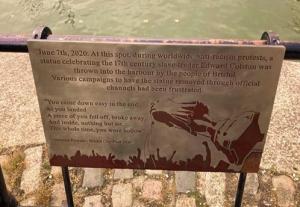
These questions are at the heart of my doctoral research at The Open University (OU). The focal point is the Black Lives Matter protest in Bristol on 7 June 2020, following the death of George Floyd, an African American man who was murdered by a white police officer in the USA. At the Bristol event, protesters toppled the statue of Edward Colston, a prominent slave trader, and rolled it into the River Avon. This act reverberated locally and globally. But beyond its iconic visual power, I argue, it was also saturated with emotion, memory, and meaning - elements sometimes elusive to conventional psychological methods.
My research takes a transdisciplinary, reflexive, and critical social psychological approach, deeply aligned with the aims of the OU’s Innovation Knowledge and Development (IKD) and the Open Psychology Research Centre (OPRC). By placing poetry at the heart of the analytic process, I explore the textures of hope, grief, anger, solidarity and resistance that were felt, performed, and theorised in and around the protest.
Poetry as Data, Theory, and Method
Poetry is rarely used in psychological research, but as Erich Fromm (1968) observed, poetry is among the most precise and powerful media for describing human experience. As Audrey Lorde (1985) says: “Our poems formulate the implications of ourselves, … our fears, our
hopes, our most cherished terrors”.
Four poems by Black Bristolians, written and performed between 2016 and 2020, form a central strand of the research dataset (comprising interviews, legal data and artistic data). Of the two written before the protest, one, ‘Name No More’, was performed online by its author, Cleo Lake, to 20,000 people at the virtual protest. Another was performed at the protest itself. The fourth, ‘Hollow’ by Vanessa Kisuule, was published in the immediate aftermath of the protest. It reached over 600,000 people online in three days and is now available as a teaching aid.
The protest poems tackle slavery, racism, colonialism, white allyship, and the politics of memory. They do not simply ‘represent’ feelings about the protest; they shape, challenge, and generate them. They work on readers and listeners, including researchers.
My doctoral study engages not only with participants and data, but also with context, colonial histories and with the positionality and emotional responses of the researcher, foregrounding the necessity of reflexivity and ‘epistemic modesty’ (Teo, 2019).
The poems explored have so far helped me locate three core themes:
- ‘Modern-day Old-school’: how colonial histories live in the present, haunting bodies and cityscapes alike
- ‘Unity and Division’: the fragile power and complexity of interracial solidarity
- ‘Moment or Movement?’: how the protest held transformative potential, but also ambivalence and paradox
Each theme is inherently temporal - revealing how hope is not only about the future but is entangled with grief, memory, and racialised histories. This challenges dominant social psychological models, which sometimes frame hope as a discrete, individualised, forward- facing emotion.
World-Making and Reflexivity
The research is part of a broader methodological commitment to world-making (Power et al., 2023), in which psychological events are understood as historically situated, socially entangled, and temporally complex. Our mixed-methods design includes:
- 22 walking interviews with protesters (retrospective accounts of their thoughts and feelings on and after the protest, collected while they retraced the protest route they took).
- The transcript of the trial of the ‘Colston Four’ charged with criminal damage.
- Artistic data: dance, sculpture, sound art, murals, photography, poetry and artist interviews.
- Ethnographic materials (including field notes of visits to local organisations and exhibitions).
- Reflexive engagement with researcher positionality, whiteness, and antiracist practice.
Reflexivity is central, and the poems play a significant role, provoking discomfort, melancholy, hope, and critical reflection. This reflexive space - sometimes marginalised in psychological research - became a generative site for exploring understanding.
Psychology in Public, Psychology as Practice
In line with OPRC’s vision of psychology as socially engaged, this work seeks to make psychological research accountable to the communities it studies, aiming to promote antiracism, amplifying marginalised voices and histories.
Through collaborations with Bristol’s M Shed Museum and activist and artist Cleo Lake, the interview extracts from protesters of African descent are featured in the permanent exhibition at M Shed Museum, where the toppled statue is now displayed, graffiti intact, alongside placards from the protest. I am also co-authoring a case study of Bristol for a forthcoming volume on decolonising education.
Reimagining Hope
Significantly, the research contributes to emerging debates about melancholic hope (Winters, 2016) and racialised time (Al-Saji, 2021). The poetry challenges us to think of hope not as naive optimism, but as something entangled with suffering, endurance, and memory. In the words of one participant, a photographer, the protest contained “the pain and the hope all at once.”
This is not a hope that erases history, but one that insists on remembering. It is a form of hope that might feel familiar to many working in critical, feminist, decolonial, or community psychology, who understand the realities of struggle and the mythical quality of oversimplified narratives of linear progress.
Towards an Open Psychology
Ultimately, this project takes seriously forms of knowledge that sometimes lie outside the conventional boundaries of psychology—poetry, ritual, embodiment, art. In doing so, it joins a growing movement (within and beyond the OPRC and IKD) to reimagine what psychological research is for, who it is with, and how it can contribute to building socially just societies.
In the final lines of Hollow, Kisuule writes of Colston’s statue, as it’s thrown in the river, “There is no poem more succinct than that”
A prompt to explore how poetry enriches understanding.
The walking interviews were supported by a British Academy Grant (Ref: SRG2021\210141; PI Professor John Dixon. The paper was awarded the 2025 IKID 2nd Year PhD Working Paper Prize. For more on this research, please contact Magi Young via [email protected]
Share this page:
Contact us
To find out more about our work, or to discuss a potential project, please contact:
International Development Research Office
Faculty of Arts and Social Sciences
The Open University
Walton Hall
Milton Keynes
MK7 6AA
United Kingdom
T: +44 (0)1908 858502
E: [email protected]


