
Gender Pay Gap Report 2020
A PDF version of this report is available.
Please note the PDF is not optimised for accessibility. For accessible version, please find the content on the page below.
Contents
- Our Open University Pay Gaps
- Our Gender Pay Gap
- What is the OU doing to address its pay gaps?
- Statement
Our Open University Pay Gaps
Our 2020 pay gaps
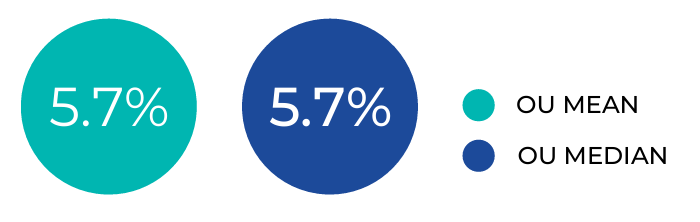
The Open University median gender pay gap for 2020 is 5.7%, an decrease of 2.2% on last year’s figure. The mean is also 5.7%.
| Year | Median | Mean |
|---|---|---|
| Open University Gender Pay Gap 2020* | 5.7% | 5.7% |
| Open University Gender Pay Gap 2019 | 7.9% | 6.5% |
| HE Sector Pay Gap 2019 | 13.7% | 14.9% |
*The Open University has excluded Consultants as the data required to calculate the gender pay gap isn't available - this is in line with the regulations. However, the OU will be looking at how this data can be captured.
Data taken at the snapshot date is 31 March 2020 (pay) and in the 12 months reference period to 31 March 2020 (bonus).
Employee groups – gender pay gap
The overall gender pay gap at The Open University has decreased in 2020. There is no median pay gap between male and female Associate Lecturers and the pay gap for staff in Professional Services roles has continued to decrease; however, these positive developments have been partially offset by the increase in the mean and median pay gap reported across our staff on Academic grades.
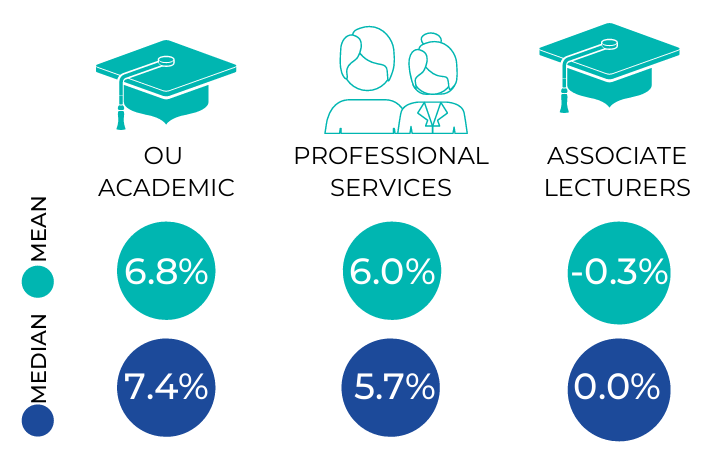
The graphic shows three staff groups. Academic staff have a median of 7.4% and a mean of 6.8%. Professional Services staff have a median of 5.7% and a mean of 6.0%. Associate Lecturers have a median of 0.0% and a mean of -0.3%.
Pay Quartiles – gender pay gap
The data shows there is a greater proportion of women across all pay quartiles. However, the proportion is higher in the first and second quartile which will be contributing to the overall median pay gap of 5.7%.

| Quartile | Female | Male |
|---|---|---|
| Lower (Q1) | 68% | 32% |
| Lower Middle (Q2) | 61% | 39% |
| Upper Middle (Q3) | 58% | 42% |
| Upper (Q4) | 55% | 45% |
Bonus gender pay gap
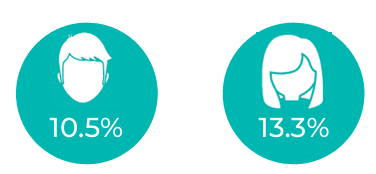
Proportion of employees receiving a bonus.
| Year | Median | Mean |
|---|---|---|
| 2020 | 0.0% | 27.0% |
| 2019 | 0.0% | 28.9% |
Whilst the median bonus pay gap is 0% for 2020, the mean bonus pay gap has decreased from 28.9% to 27.0%. This is a result of the different types of bonuses paid. This year the gap is largely attributable to contractual payments being made to colleagues who are responsible for securing new business. Of these eligible employees the majority are male.
Why the gender pay gap and equal pay are not the same
Analysing and reviewing a gender pay gap is not the same as doing an equal pay review.
A gender pay gap is the percentage difference between the average hourly earnings of men and women across the organisation.
Equal pay is where men and women are paid the same amount for equal work.
What is the OU doing to address its pay gaps?
We have more women than men in lower paid roles within our Academic and Professional Services employee groups which is a key contributor to the pay gap. To close the pay gap, our ambition is to:
- Improve the representation of women in senior roles and work towards a target of increasing the proportion of women who hold these roles by 2022.
- Improve managers capability to recruit, manage and develop diverse teams with clear completion targets for this year.
- By 2022 every interview panel member to have received training on Recruitment, Selection and Interviewing. We are currently trialling anonymous recruitment in some units.
- Review the promotion processes for Senior Academic and Academic Related grades.
- Continue to support colleagues applications for development in underrepresented groups.
- Aurora: a women only leadership programme aimed at giving women more confidence to work at senior levels in the organisation. We supported 30 colleagues in the 2020/2021 cohort.
- Increase the number of Black female professors through participation in the '100 Black female professors' UK-wide project.
- Continue to embed Athena SWAN actions which contribute to the career progression of women, at both institutional and School levels.
- Significantly invest into our people systems which will enhance the data and insight available to us. In turn this will help inform where we prioritise our actions around our broader Equality, Inclusion and Diversity agenda.
The recent appointment of a Dean for Equality, Diversity and Inclusion (EDI) at the Open University will play a leading role in our quest to promote equality and will work directly alongside the Vice-Chancellor.
*Aurora is the Leadership Foundation's women-only leadership development programme.
**Athena SWAN is a scheme that recognises and celebrates good employment practice for women in higher education and research
Statement
" Whilst it's positive that the Open University's gender pay gap for 2020 has decreased by 2.2%, we are mindful that any gender pay gap, no matter how small, is unwelcome. We will continue to work on closing this even further as part of our Equality Diversity & Inclusion agenda."
Professor Tim Blackman, Vice-Chancellor
Caragh Molloy, Group People Director
Contact us
Equality, Diversity and Inclusion
The Open University
Walton Hall
Milton Keynes
MK7 6AA
Email [email protected]


Explore

Undergraduate
Postgraduate
Policy
-
Follow us on Social media
-


