
Gender and Ethnicity Pay Gap Report 2022
A PDF version of this report is available.
Please note the PDF is not optimised for accessibility. For accessible version, please find the content on the page below.
Contents
- Our Open University Pay Gaps
- Our Gender Pay Gap
- Our Ethnicity Pay Gap
- What is the OU doing to address its pay gaps?
- Statement
Our Open University Pay Gaps
This report provides a summary of our gender and ethnicity pay gaps at The Open University in 2022.
All companies with a workforce of more than 250 staff are legally required to publish data on their gender pay gap. From 2021, The Open University has committed to also publishing its ethnicity pay gap. This is part of our wider plan for embedding equality, diversity and inclusion (EDI) within the institution and affording greater transparency.
Our 2022 pay gaps
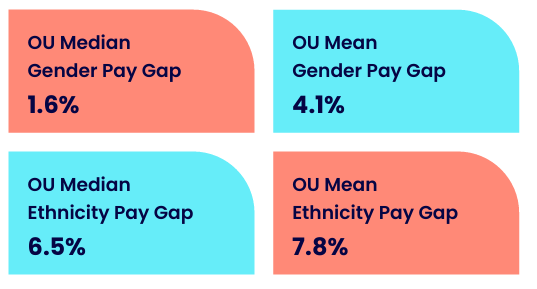
The Open University's gender pay gap is 1.6% (median) and 4.1% (mean). The ethnicity pay gap is 6.5% (median) and 7.8% (mean).
Our Gender Pay Gap
What is the gender pay gap?
The gender pay gap is an equality measure that shows the difference in average (mean) and median earnings between women and men. It is used to help us understand any inequality in earnings between women and men and identify any issues that need to be addressed. The figures contained in this report have been calculated using the methodology stipulated by UK legislation.
| Year | Median | Mean |
|---|---|---|
| Open University Gender Pay Gap 2022 | 1.6% | 4.1% |
| Open University Gender Pay Gap 2021 | 13.3% | 8.7% |
| Open University Gender Pay Gap 2020 | 5.7% | 5.7% |
| Education Sector Pay Gap 2021 | 21% | 15.7% |
Our 2022 median and mean gender pay gaps have decreased, showing positive movement from 2021. Data was taken as a snapshot on 31 March 2022 (pay) and in the 12 months up to 31 March 2022 (bonus).
Employee groups – gender pay gap
Looking at the main employee groups, the mean pay gaps have decreased for all staff groups.
The mean academic staff pay gap has decreased from 8.1% in 2021 to 7.6% in 2022. The median gap for the same group also decreased from 7.2% in 2021 to 7.1% in 2022.
The professional services staff mean has fallen from 6% in 2021 to 5.9% in 2022, but has seen an increase in the median, rising from 6.2% to 7.8%.
The mean and median pay gaps between men and women are smallest for Associate Lecturers. The mean pay gap has decreased from 3.7% in 2021 to -1.7% in 2022 and the median has decreased from 1.7% in 2021 to -0.3% in 2022.
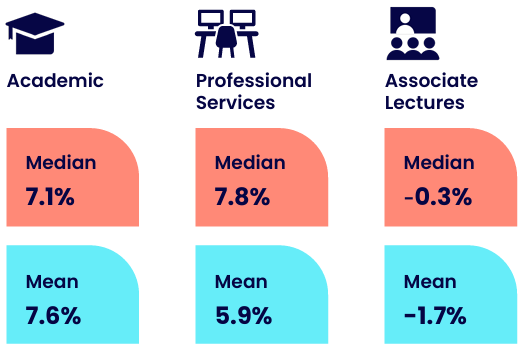
The graphic shows three staff groups. Academic staff have a median of 7.1% and a mean of 7.6%. Professional Services staff have a median of 7.8% and a mean of 5.9%. Associate Lecturers have a median of -0.3% and a mean of -1.7%.
Pay Quartiles – gender pay gap
The data shows the distribution of women and men between all pay quartiles. Women are in the majority of all four pay quartiles. Although the proportion in the top two quartiles is lower than the bottom two, this proportion has been increasing year on year, which is contributing to a narrower pay gap.
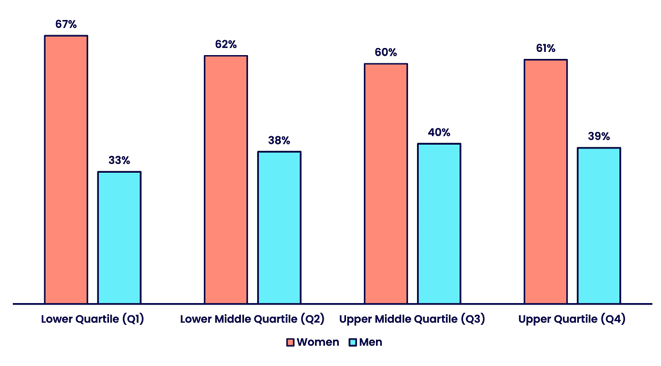
Across all pay quartiles, Women represent the majority.
| Quartile | Female | Male |
|---|---|---|
| Lower (Q1) | 67% | 33% |
| Lower Middle (Q2) | 62% | 38% |
| Upper Middle (Q3) | 60% | 40% |
| Upper (Q4) | 61% | 39% |
Bonus gender pay gap
Whilst the median bonus gender pay gap has remained static at 0% in 2022, the mean gender bonus pay gap has increased from 1.7% to 22.5%. Our increased mean gap is due to us returning to usual bonus distribution after awarding all staff a one-time bonus payment for the extra work carried out during the pandemic in 2021. Reported bonus payments only include contractual payments to the small proportion of OU employees who are responsible for securing new business contracts.
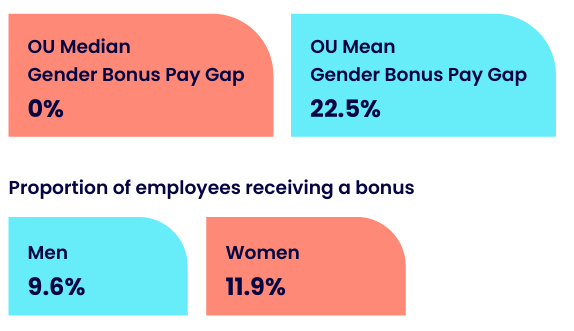
The OU median gender bonus pay gap is 0% and the OU mean gender bonus pay gap is 22.5%. The proportion of employees receiving a bonus is 9.6% for Men and 11.9% for Women.
Understanding the changes to our gender pay gap
Movement within quartiles: For the gender pay gap, representation of women in the upper quartile has increased this year from 42% to 60%. Across the senior grades there were more women as new hires, which increased the median hourly rate at these grades and brought the median hourly rate for women closer to the median hourly rate for men.
Associate Lecturer (AL) contract changes: The Associate Lecturer contract change programme has made changes to our gender pay gap. Associate Lecturers permanent FTE values have now been confirmed with them and fully incorporated into OU Systems.
The AL’s median gender pay gap has decreased from 1.7% in 2021 to -0.3% in 2022. Due to the population size of this employee group, there is a significant impact to the overall OU pay gap.
Our Ethnicity Pay Gap
What is the ethnicity pay gap?
The ethnicity pay gap is calculated using the same calculation methodology as for gender pay gap reporting and is expressed as a percentage of average non-minority earnings.
This is the second year we have published the ethnicity pay gap, in line with our new EDI strategy to show greater transparency, demonstrate accountability and identify inequalities that need to be addressed.
Both our mean and median pay gaps have decreased from 2021.
| Year | Median | Mean |
|---|---|---|
| Open University Gender Ethnicity Pay Gap 2022 | 6.5% | 2.8% |
| Open University Gender Ethnicity Pay Gap 2021 | 20.1% | 13.2% |
Pay Quartiles – ethnicity pay gap
Our ethnicity pay gap has decreased due to greater representation of Black, Asian and Minority Ethnic colleagues in the upper quartile.
Whilst the data shows that there is uneven distribution in the upper pay quartiles, we have seen an increase in the representation of Black, Asian and Minority Ethnic colleagues in the upper quartile from 7% in 2021 to 10% in 2022.
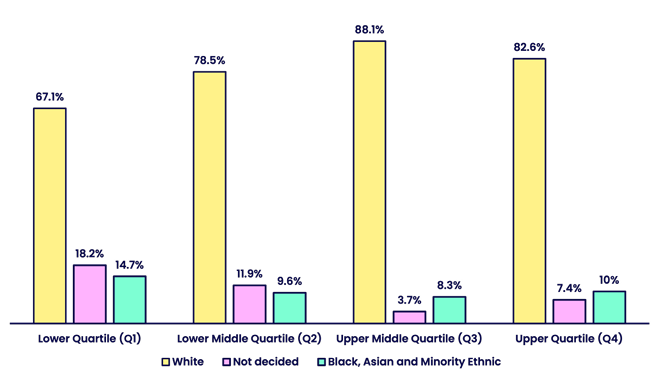
Across all pay quartiles, white people represent the majority.
| Quartile | Black, Asian and Minority Ethnic | Not decided | White |
|---|---|---|---|
| Lower (Q1) | 14.7% | 18.2% | 67.1% |
| Lower Middle (Q2) | 9.6% | 11.9% | 78.5% |
| Upper Middle (Q3) | 8.3% | 3.7% | 88.1% |
| Upper (Q4) | 10% | 7.4% | 82.6% |
Bonus ethnicity pay gap
This is the first year we are reporting on the OU Ethnicity bonus pay gap in order to further the transparency of our reporting and present a similar level of information to our gender pay gap. The ethnicity bonus pay gap shows a median pay gap of 0% and a mean pay gap of 13.1%.
As with our gender bonus pay gap, the increased mean gap is due to us returning to usual bonus distribution.
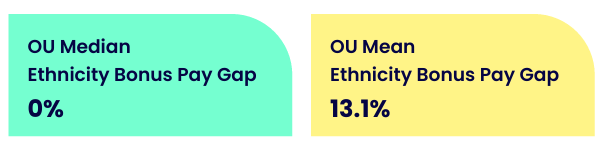
The OU median ethnicity bonus pay gap is 0% and the OU mean ethnicity bonus pay gap is 13.1%.
What is the OU doing to address its pay gaps?
Though we have seen a significant decrease in both our gender and ethnicity pay gaps, we remain committed to addressing this through long-term, meaningful actions.
We will work towards maintaining our overall female staff representation in senior roles while increasing the proportion of Black, Asian and Minority Ethnic staff in upper pay quartiles.
This year we have introduced our Institutional Equality, Diversity and Inclusion (EDI) Plan and reviewed our Equality Scheme to outline our ambitions and the actions we need to drive positive change. Through ongoing actions we aim to grow our diverse talent and create an equitable and inclusive culture that will remove barriers to opportunity.
Fair recruitment and selection
- A systems change means our new recruitment and onboarding module will be implemented in 2023 to bring all existing recruitment practices together into one streamlined system. This will allow us to record, monitor and improve the gender constitution of our recruitment panels, reduce manual processes and bias at all stages of recruitment/selection and allow for alternative recruitment options.
- We will introduce focus groups to track gendered perceptions of fairness in recruitment and selection.
- We are reviewing pay for new hires and reassessing our processes and pay policies accordingly.
- We will continue initiatives that address imbalance of opportunity or disadvantages that individuals of any protected characteristic(s) may face, including anonymous recruitment and our Positive Action policy introduced in Autumn 2022.
Promotion, development and progression
- We will support the progression of women and Black, Asian and Minority Ethnic individuals as part of our Executive Leadership programme.
- All units and faculties will put in place clear mentoring arrangements which enable staff to access mentoring support at a variety of career stages including induction, role change, seeking promotion and career development. A reciprocal mentoring programme will be offered to ensure staff have the opportunity to learn from the lived experience of diverse colleagues.
- We will continue to engage in leadership development programmes by offering places on the Aurora Programme for women and supporting career progression for Black women through participation in the ‘100 Black Women Professors NOW’ UK-wide project.
Charters and Initiatives
- We will continue engagement in Athena Swan and the Race Equality Charter. These are rigorous self-assessment processes involving significant data analysis and evaluations of staff representation, experience, reward and recognition and career progression across the institution.
- The University will convene the Athena Swan self-assessment team to initiate our silver submission and prioritise actions from the Athena Swan action plan. We aim for all school submissions to be made by the end of 2024.
- Our Race Equality Charter Self-Assessment Team resumed meeting in December 2022 and are preparing our submission.
Pay gap reporting and data capturing
- We will continue to support units to understand their pay gaps and include remedial actions as part of the 2023/2024 Unit Business Planning Process.
- We will prioritise actions to begin reporting our disability pay gap. Any existing challenges/barriers to publishing this data will be tackled with robust interventions.
Statement
"At the Open University we are committed to addressing both our ethnicity and gender pay gaps through data-driven, meaningful actions. We will continue to monitor and address these gaps as part of our Equality, Diversity and Inclusion agenda."
Contact us
Equality, Diversity and Inclusion
The Open University
Walton Hall
Milton Keynes
MK7 6AA
Email [email protected]


Explore

Undergraduate
Postgraduate
Policy
-
Follow us on Social media
-


